
Science and Space
XRISM watches a pulsar gulp a blue hypergiant’s stellar wind
What happened
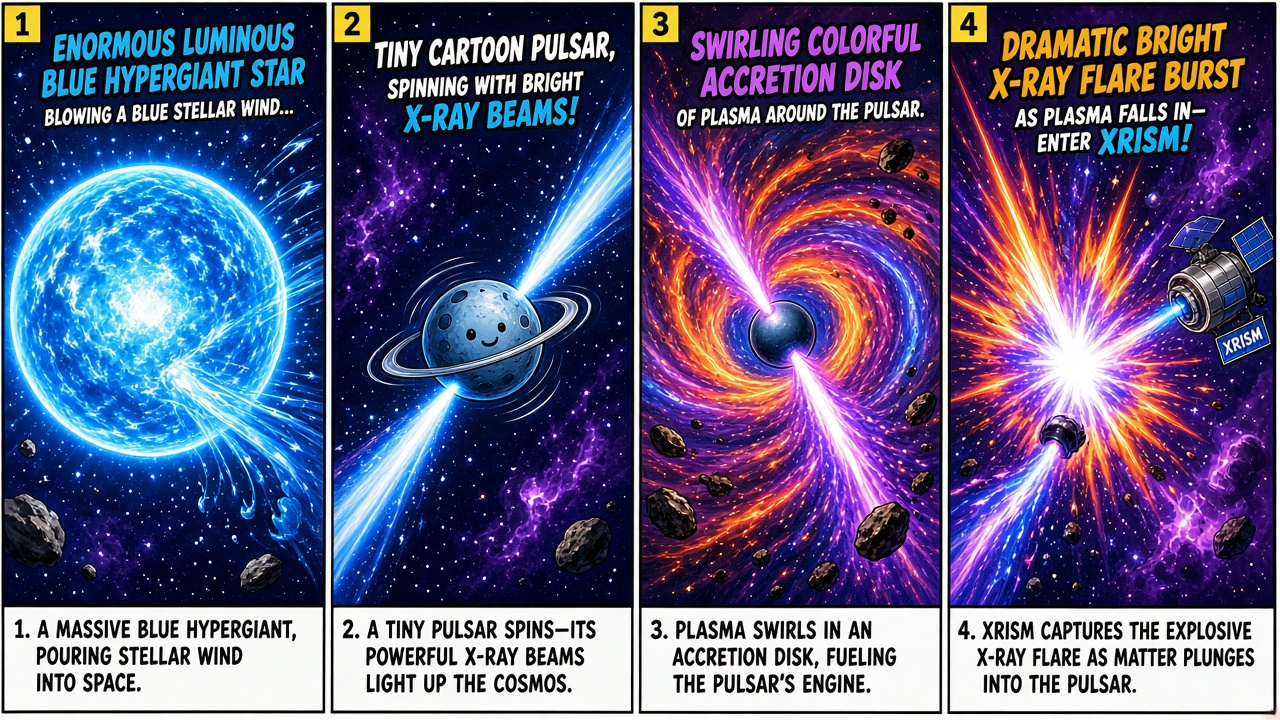
NASA’s Scientific Visualization Studio posted Friday’s XRISM science package: the Japan-led X-ray Imaging and Spectroscopy Mission has directly observed a giant star’s stellar wind being captured by its compact companion and powering strong X-ray flares — a wind-plasma signature astronomers say has never been seen so clearly. The system is BP Crucis, about 13,000 light-years away in Crux. The primary, Wray 977, is a blue hypergiant roughly 40 times the Sun’s mass and 60 times its size; its companion is the neutron-star pulsar GX 301-2, packing more than a solar mass into a city-sized ball that rotates every 11 minutes. That is the Science filing: a wind, a gulp, and an X-ray flare you can almost storyboard.
Twice each 41.5-day orbit, near closest and farthest approach, the pulsar lights up for several days as it crosses a dense plasma stream sculpted by its gravity. XRISM’s Resolve instrument, jointly developed by NASA and JAXA, watched for about 16 hours on Feb. 1, 2025, near the end of a stronger flare. Highly ionized iron absorption lines are redshifted — gas racing toward the pulsar at around 335,000 mph (540,000 kph). Artist concepts show a messy accretion disk forming, breaking up into direct infall, then rebuilding spinning the other way as the pulsar exits the stream. Deep space blues and flare gold, white gutters, cartoon astronomy only. Source: https://svs.gsfc.nasa.gov/15099/.
Readers get the wind-capture first, the 13,000-light-year address, the hypergiant-to-pulsar scale contrast, the 11-minute spin, the twice-per-orbit flare clock, and the Resolve redshift speed — a Saturday science comic without inventing secret signals.
Why it matters
Binary X-ray machines are usually inferred from brightness curves; Resolve’s iron-line redshift turns “the wind fell in” into a measured velocity arrow. Color on the blue hypergiant and the pulsar beams. White gutters. Readers get the disk-to-direct-infall sequence from the Goddard concepts, the NASA–JAXA instrument credit, and the source URL on the page.
Conclusion
XRISM’s Resolve instrument caught stellar-wind plasma falling onto pulsar GX 301-2 in the BP Crucis system at roughly 335,000 mph — the clearest wind-accretion signature yet — as released by NASA’s Scientific Visualization Studio on Sept. 18, 2026. Source: https://svs.gsfc.nasa.gov/15099/