
Science and Space
Some quantum-gravity clues may be two maps of the same hill
What happened
Two theories still will not share a desk. Quantum mechanics describes atoms and molecules. Einstein’s gravity describes stars, black holes, and the expanding universe. Physicists have spent decades hunting a single theory of quantum gravity that would put them in the same sentence. A new paper in npj Quantum Information, covered by ScienceDaily on Aug. 29, 2026 from materials provided by Kyushu University, says some of the experimental “tells” people have been treating as quantum gravity may not be unique. The authors are Joshua Foo of Kyushu University’s Institute for Advanced Study, Cendikiawan Suryaatmadja, Robert B. Mann, and Magdalena Zych of Stockholm University, with Waterloo also in the collaboration. Their framework is called the Relativity of Spacetime Superpositions.
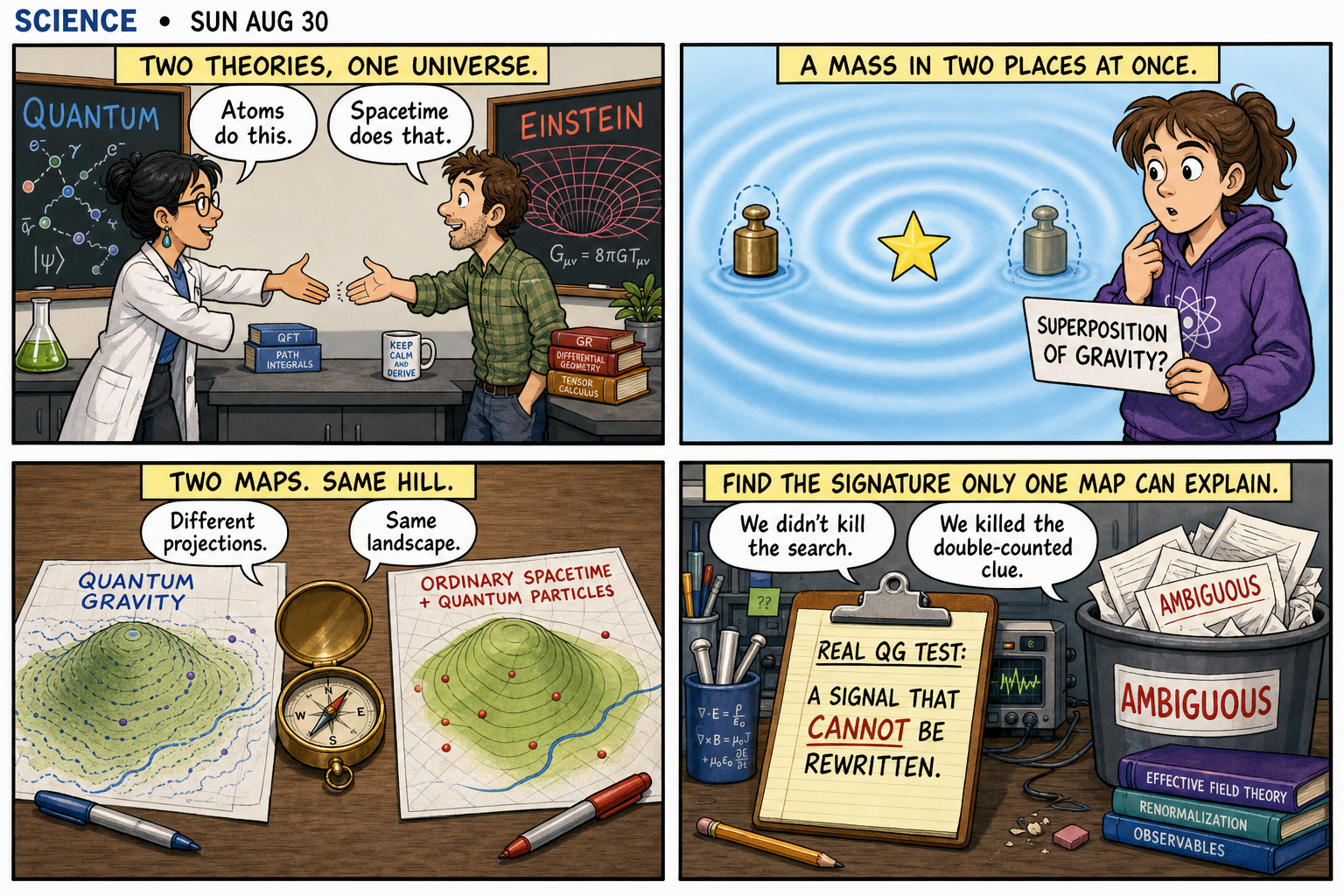
The usual picture is this: quantum mechanics lets an object sit in more than one place at once, a fact already shown with atoms and even small pieces of metal. Einstein’s gravity is spacetime itself, which can bend, flatten, and carry waves that detectors have measured. So a lot of proposed tests assume that the spacetime around a delocalized mass should also occupy several states at once, a quantum superposition of geometries. Foo’s group shows that many of those scenarios can be rewritten as quantum particles moving through ordinary, classical gravity and spacetime. No extra quantum behavior of gravity is required for the math to match. Foo’s line, as ScienceDaily quotes it, is that some setups can be viewed from two equally valid perspectives: gravity in a quantum superposition, or quantum particles in an ordinary gravitational field. The team’s metaphor is two maps of the same landscape drawn in different projections. The maps look different. The hill is the same.
Why it matters
That is not a claim that gravity is classical, and it is not a claim that quantum gravity does not exist. Zych is explicit: the work does not say such experiments rule out quantum gravity. It helps sort which signatures would actually require a quantum description of gravity and which ones could arise from more familiar physics. The paper applies the idea to scenarios that have been labeled quantum-gravitational in the literature, including proposals to test gravitationally induced entanglement and the decoherence of gravitational sources. On decoherence, the result is that the fading of a superposition is not a fundamental property of gravity in those setups. It depends on whether there are external systems around that define a relative set of coordinates, which is the only way a “spatial superposition” gets a physical meaning. If you can always change coordinates and recover a single background, you have not yet seen gravity go quantum.
The practical payoff is a cleaner shopping list for the next experiment. Foo’s closer is the one the strip is built on: before you can test gravity’s quantum nature, you first need to know what evidence would prove you found it. History is allowed a small cameo because the university release makes it: GPS, lasers, and modern electronics all grew out of theoretical quantum physics and Einstein’s gravity. Nobody is promising a gadget from this paper. The claim is narrower and more useful. If two descriptions fit the same data, you have an ambiguity, not a discovery. Design the measurement so that only one description survives.
Conclusion
Some of the clues that were supposed to show spacetime going quantum may be two maps of the same hill. Kyushu, Waterloo, and Stockholm did not kill the search for quantum gravity. They took a red pen to the signatures that can be rewritten as ordinary spacetime with quantum particles in it. The next lab that wants to claim a superposition of geometries has to find a signal that cannot be projected onto the other map. That is the whole package: a Nature-family theory paper, a Saturday ScienceDaily write-up, and a comic that refuses to treat a change of coordinates as a new law of nature.
Source: ScienceDaily