
Conspiracy Theories
The book nobody can read is still unread
What happened
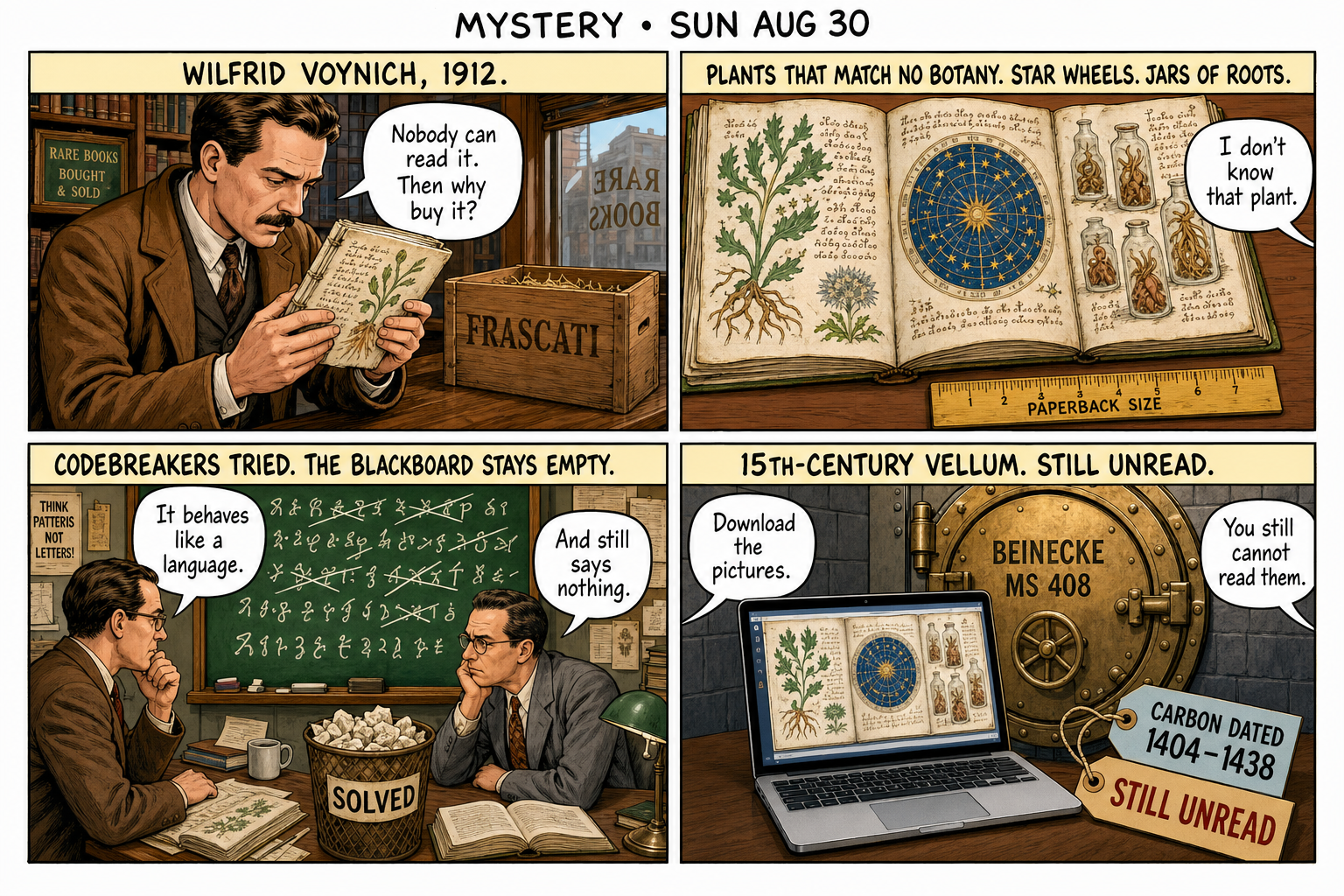
In 1912, rare book dealer Wilfrid M. Voynich bought a small illustrated codex from the Jesuit College at Frascati near Rome and spent the rest of his career insisting it would startle the scientific world. History.com’s Dave Roos, in a May 27, 2025 explainer still current as a standard account of the mystery, walks the object as it actually exists: roughly the size of a paperback, 6.2 by 8.8 inches, more than 230 pages of an alphabetic-looking script nobody has ever matched to a known language, crowded with plants, stars, bathing figures, and jars. Yale’s Beinecke Rare Book and Manuscript Library has held it since 1969 as Beinecke MS 408. High-resolution images of every folio are online. The text is still unread.
Radiocarbon work at the University of Arizona, reported in the History.com piece and corroborated by Smithsonian Magazine’s earlier primers, dates the calfskin to the early 15th century, about 1404 to 1438. The ink is consistent with the same period, which knocks out the old claim that English friar Roger Bacon wrote it two hundred years earlier, and also knocks out the rumor that Voynich forged the whole thing on antique vellum. The pictures suggest at least six sections: herbal plants that do not match known botany; cosmological wheels whose constellations are unrecognizable; a zodiac that almost looks like other 15th-century charts; a “balneological” run of small nude figures in green pools; pharmaceutical jars of roots; and a “recipes” or “star” section of some 300 short paragraphs, each marked with a flower-like star. None of that is a translation. It is a table of contents for a book whose language has no second witness.
Why it matters
The Voynich is the parlor mystery that keeps eating professionals. History.com notes that cryptologists including Alan Turing spent years on it and left empty-handed. William and Elizebeth Friedman, preeminent cryptologists of their day, concluded after decades and early computer analysis that the text was probably an invented language, not a substitution code. Science journalist Garry Shaw, who researched the manuscript for Cryptic, tells Roos the hook is the feeling that if you just stare a little longer, the page will give. René Zandbergen, a foremost specialist, has a standing warning that is still the right one: if you just heard the manuscript has been solved, it has not. Claims arrive every few years in Hebrew, Latin abbreviation, Nahuatl, and whatever else is fashionable. They do not survive review.
Statistically the writing is not noise. Word frequencies behave like a real language. Some clusters appear only in the herbal pages, others only in the astrological ones, which is the pattern you would expect if the pictures and the text were about the same subjects. Shaw points out that most medieval ciphers are simple substitutions meant to hide a sentence or two, not 200-plus pages of continuous prose. If Voynichese is a cipher, it is more complex than anything else from its century. If it is a made-up language, it predates Europe’s later invented-language craze by a couple of hundred years. If it is a hoax, it is a hoax that took five scribes, real 15th-century materials, and enough linguistic structure to fool network models in the 21st. Shaw leans hoax and hopes he is wrong. That is the entertainment of it: a riddle that still has a body, a vault, and a digital facsimile, and still no sentence you can read aloud.
Conclusion
The manuscript has not become less strange because it is downloadable. Yale keeps the object in a vault; the internet keeps the pages in every amateur’s folder; History.com’s explainer keeps the facts in one place: 15th-century vellum, unknown script, failed decipherment, possible hoax, possible lost language, possible cipher too hard for the people who broke the hardest codes of their century. The strip’s four beats are the 1912 purchase, the plants that do not exist, the blackboard that never fills in, and a door that still says unread. That is pop-history mystery, not a plot about anyone in power. The book is the conspiracy. Nobody has cracked it.
Source: History.com