
Finance
An ETF is a basket that trades like a stock
What happened
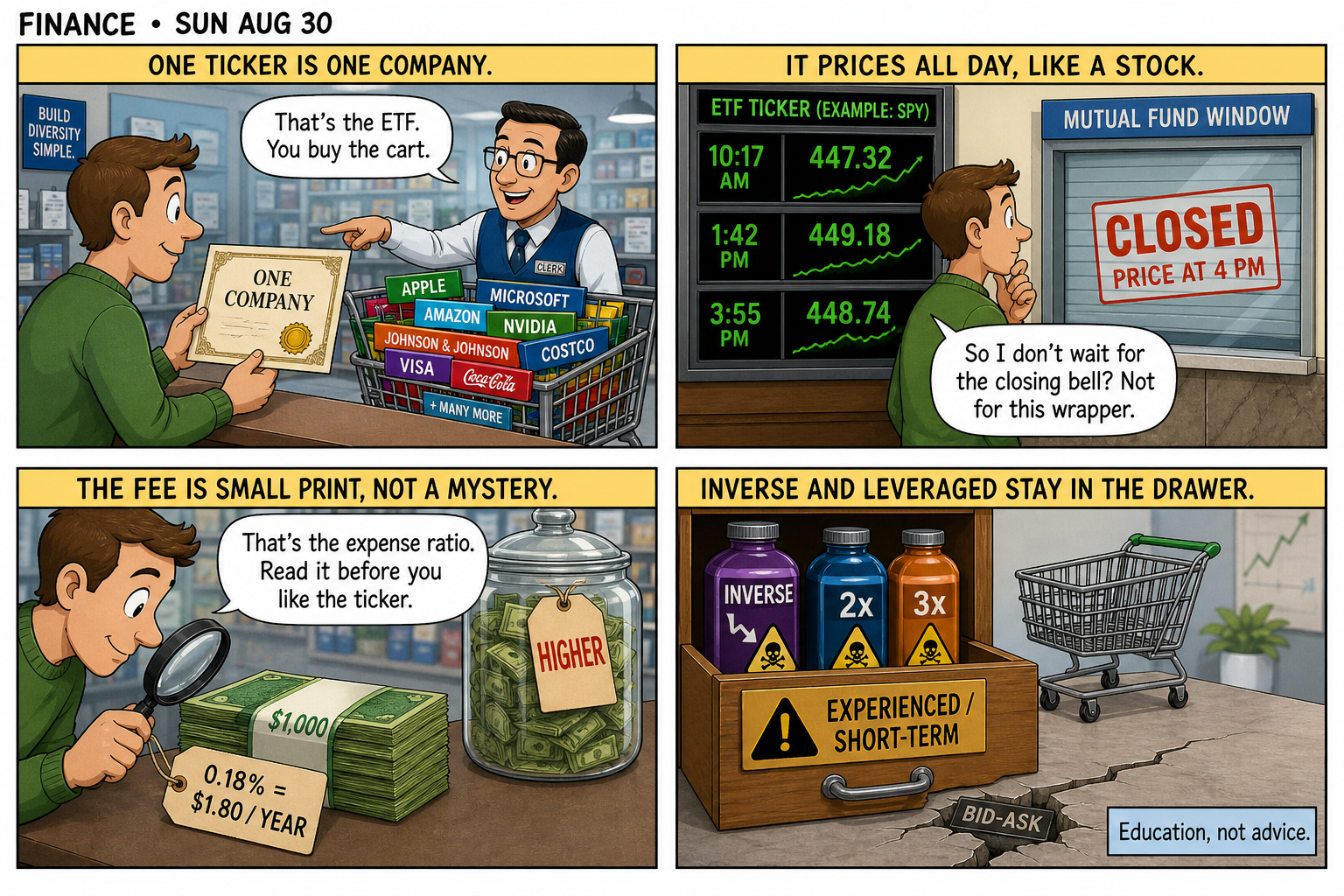
An exchange-traded fund is a basket with a ticker. Fidelity’s Learning Center, dated July 6, 2026, defines an ETF as a tradeable investment fund that holds many investments and is generally organized around a strategy, theme, or market exposure. That can mean tracking a sector such as technology or energy, holding a type of bond such as high-yield or municipal, or copying a market index such as the S&P 500 or the Nasdaq composite. Unlike a mutual fund, an ETF trades on an exchange the way a stock does, and its price moves throughout the day. That is the whole mechanical point: you are not waiting for a once-a-day net asset value after the close. You can buy it in a brokerage account, and at most places in a retirement account such as a Roth IRA or a traditional IRA. Some providers also allow ETFs in an HSA.
The market is not one flavor. Fidelity lists index ETFs that track a benchmark, actively managed ETFs run by a team trying to beat a passive fund, fixed-income ETFs for Treasuries, corporates, munis, international, and high-yield bonds, style ETFs built around growth or value or a market-cap slice, sector and industry ETFs, commodity ETFs that track timber, oil, or gold, and foreign-market ETFs tied to indexes such as Japan’s Nikkei or Hong Kong’s Hang Seng. It also flags inverse ETFs, which are meant to profit from a decline, and leveraged ETFs, which try to multiply a move by two or three times, up or down. Those last two, the page says, are risky and more complex and are generally used by experienced investors for short-term trading. In one trade, an ETF can give you exposure to hundreds or even thousands of bonds, stocks, or other holdings, so the fund’s performance is the pile, not one company’s day. A single stock is a share of one public company. Diversifying does not guarantee you will not lose money, Fidelity notes, but it can help protect a portfolio from the ups and downs of one name.
Why it matters
The comparison that actually changes how you use one is ETF versus mutual fund, not ETF versus “the market.” You can buy and sell an ETF whenever the market is open and watch the price in real time. Mutual funds typically price once a day after the close. Pricing is generally lower than a comparable mutual fund because of how the security is structured, Fidelity says, including for many active ETFs. Holdings transparency is the other split: ETFs share their ingredients somewhat frequently, while mutual funds typically disclose quarterly with a 30-day delay. On fees, both vehicles have an expense ratio. Fidelity’s example is a 0.18% expense ratio on a $1,000 investment, which is $1.80 a year. Administrative costs tend to be lower than those of like mutual funds. Tax treatment is the quieter advantage: when a mutual fund sells holdings, capital gains can land on shareholders. ETFs are structured so you typically realize a gain or a loss when you sell your own shares, not every time the fund rebalances.
The honest drawbacks sit on the same page, which is why they belong in the strip. Some firms still charge commissions. There is also a bid-ask spread: the gap between what a buyer will pay and what a seller will take. Specialized ETFs with low volume can have a wide spread, which means paying a premium to get in or taking a discount to get out, or waiting. You do not get to customize the basket. If a name in the fund bothers you, you still own it for as long as you own the ticker. Index and other passive ETFs can also miss the benchmark, which is tracking error, and Fidelity’s advice is to look at how closely a fund has actually followed its index before you treat the ticker as a copy. None of that is a buy list. It is the user’s manual for a wrapper that looks like a stock and behaves like a cart.
Conclusion
An ETF is a basket that trades like a stock, not a crystal ball and not a single company. If the explainer still sounds useful, Fidelity’s steps are an account that can trade ETFs, homework on the fund’s objective, holdings, and expense ratio, then a ticker when you are ready, plus a plan for when you would sell. Inverse and leveraged products stay in the warning drawer. This is education, not a recommendation, and it is not a markets piece.
Source: Fidelity Learning Center