
Science and Space
NASA’s LRO spots McGetchin: largest newly formed Moon crater on record
What happened
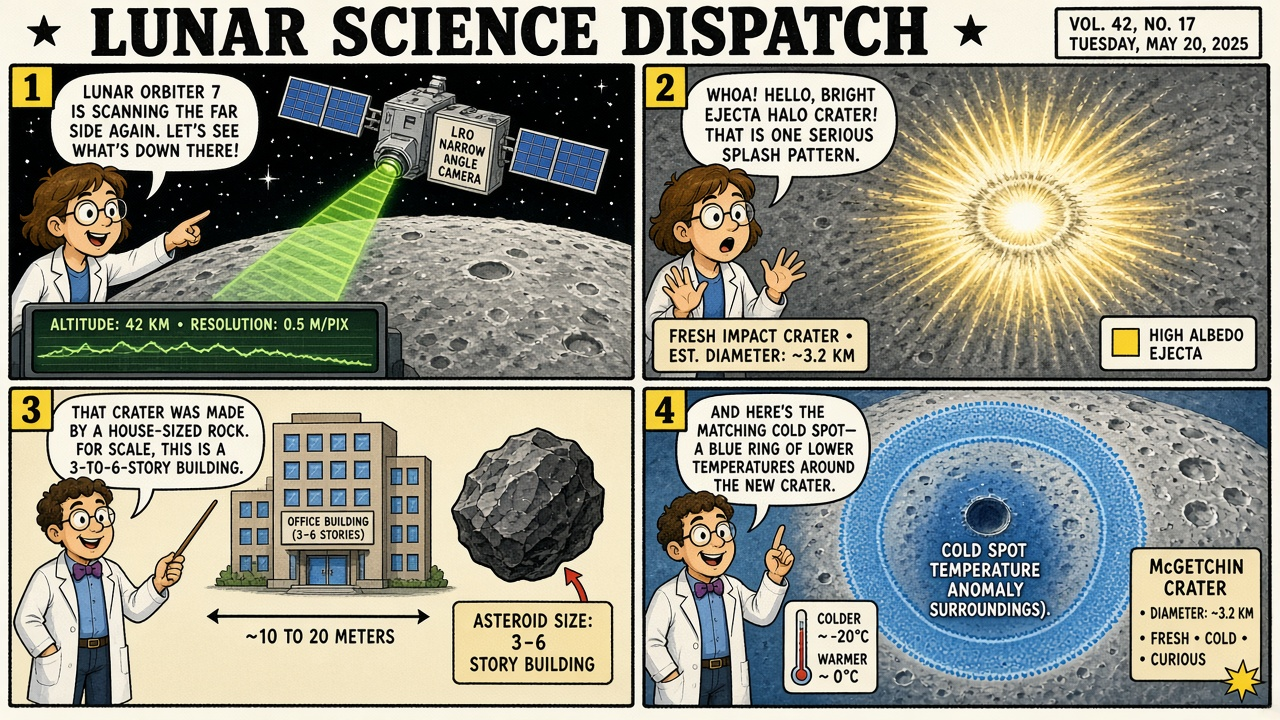
NASA Science’s Lonnie Shekhtman, writing Sept. 16, 2026, reports that Robert Wagner — an image-processing specialist working with Lunar Reconnaissance Orbiter Camera data — found the largest newly formed crater ever identified in the solar system while checking a change-detection Moon map. Scientists detailed the find in a pair of Science Advances papers. The crater, officially named McGetchin after lunar scientist Tom McGetchin, formed on the Moon’s eastern edge sometime between April 11 and May 22, 2024, when a comet or asteroid roughly the size of a three- to six-story building hit. That is the Science filing: a fresh hole, a century-class impact, and orbiter receipts.
The crash left a crater about 728 feet wide — two football fields end to end — and 141 feet deep, deep enough to stack three yellow school buses. Wagner spotted it on Oct. 24, 2025, as a bright ejecta splash with a dark halo in Wide-Angle Camera difference maps; Narrow-Angle Camera follow-ups sharpened the shape. LRO’s Diviner thermal instrument later mapped a roughly 4-mile-wide “cold spot” around the crater that runs about 16 degrees Fahrenheit cooler at night than surroundings, because the impact fluffed lunar regolith into a less heat-holding blanket. Bright lunar grays with cold-spot blue, white gutters, cartoon researchers only — never living likenesses. The NASA Science URL is the receipt.
Impacts without an atmosphere are routine on the Moon; LRO has flagged at least 1,000 new craters and ~100,000 surface changes. Most new pits are tiny. McGetchin is the once-in-a-century class. Readers get the 728×141-ft dimensions, the 2024 impact window, the Oct. 24, 2025 discovery date, the Diviner −16°F night cold spot, the three-to-six-story impactor scale, and the Science Advances timing — one Friday Science slot from Goddard’s wire.
Why it matters
A crater that large, found by stacking years of orbiter frames, is a reminder that the Moon is still being hit hard enough to rewrite maps. The cold-spot physics matters for anyone planning wheels and landers: impacts can fluff ground far beyond the rim. Color on the halo and the icy blue ring. White gutters. Readers get Wagner’s find, McGetchin’s name, the once-in-a-century estimate, Diviner’s thermal follow-up, and the source URL on the page.
Conclusion
NASA’s Lunar Reconnaissance Orbiter team identified McGetchin — a 728-foot-wide, 141-foot-deep crater from a 2024 building-scale impact, the largest newly formed crater found in the solar system — with a miles-wide nighttime cold spot about 16°F cooler than surroundings, as reported Sept. 16, 2026, on NASA Science. Cartoon only. Source: https://science.nasa.gov/solar-system/moon/nasas-moon-orbiter-spots-new-once-in-century-moon-crater/
Source: NASA Science