
Science and Space
Webb finds IC 348 brown dwarfs as light as 2× Jupiter mass
What happened
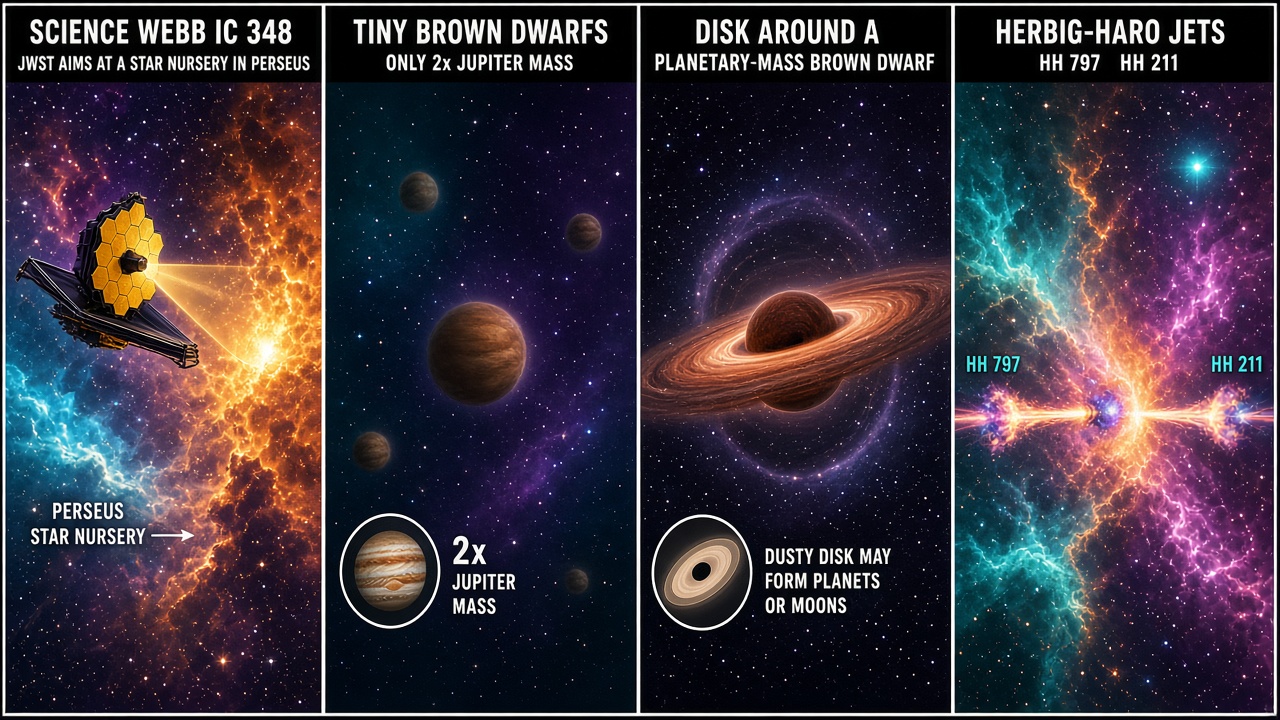
NASA Science, dated September 15, 2026, reports that NASA’s James Webb Space Telescope observed IC 348, a star-forming region about 1,000 light-years away in the constellation Perseus, and found brown dwarfs with masses as low as just twice the mass of Jupiter — only about 0.19 percent of the Sun’s mass. Those are described as the least massive brown dwarfs known, and their existence poses a challenge to models of how stars form. The release frames the panorama as one of the largest Webb images released to date of this nearby nursery.
The team used Webb’s NIRCam (Near-Infrared Camera) in 2024 to capture the warm glow of young brown dwarfs and newborn stars, then followed up with Webb’s NIRSpec (Near-Infrared Spectrograph) in 2025 for spectroscopic mass work after selecting candidates by color and brightness. Earlier 2022 Webb work on IC 348 had reached brown dwarfs at three to four Jupiter masses; the deeper campaign pushes the floor to about two. One of the lightest newfound brown dwarfs showed signs of a disk, suggesting small planets could be forming around an object that is itself only planet-mass scale. Spectra also showed a feature attributed to an unidentified hydrocarbon seen so far only in the atmospheres of the lowest-mass brown dwarfs. The image’s upper-right corner hosts Herbig-Haro jets, including the long narrow HH 797 (two protostars with nearly parallel outflows) and propeller-shaped HH 211. Bright JWST gold and nebula cyan. White gutters.
A dated deep-field star-formation result with a new mass floor is a clean Science slot. Readers get the Sept. 15 NASA stamp, IC 348 at ~1,000 ly in Perseus, brown dwarfs down to 2× Jupiter / 0.19% Sun, the challenge to formation models, the disk around one lightest object, the unidentified hydrocarbon, HH 797 and HH 211, and the NIRCam 2024 / NIRSpec 2025 sequence — not a rewrite of every prior brown-dwarf catalog paper. The cartoon is illustrative if panels invent named planet slogans the release does not pin; verified prose wins.
Why it matters
Readers get the instrument (Webb), the region (IC 348 / Perseus / ~1,000 ly), the 2× Jupiter-mass floor, the 0.19% Sun line, the challenge to formation models, the disk around one lightest brown dwarf, the unidentified hydrocarbon feature, HH 797 and HH 211, and the NIRCam–NIRSpec timeline. Keep politics out. Keep the NASA Science URL on the page. Bright brown-dwarf dots and telescope gold. White gutters. Objects lighter than theory expected force a rethink of the low-mass end of star formation — that is the strip.
Conclusion
NASA’s Sept. 15 release on Webb’s IC 348 panorama reports brown dwarfs as light as twice Jupiter’s mass (about 0.19% of the Sun), challenging formation models, with one of the lightest showing a disk, an unidentified hydrocarbon feature in the lowest-mass spectra, and Herbig-Haro jets HH 797 and HH 211, from NIRCam 2024 and NIRSpec 2025 observations about 1,000 light-years away in Perseus. Source: https://science.nasa.gov/missions/webb/nasas-webb-reveals-dynamic-panorama-of-star-formation/
Source: NASA Science