
Science and Space
NASA activates Roman’s Wide Field Instrument; coronagraph in checkout
What happened
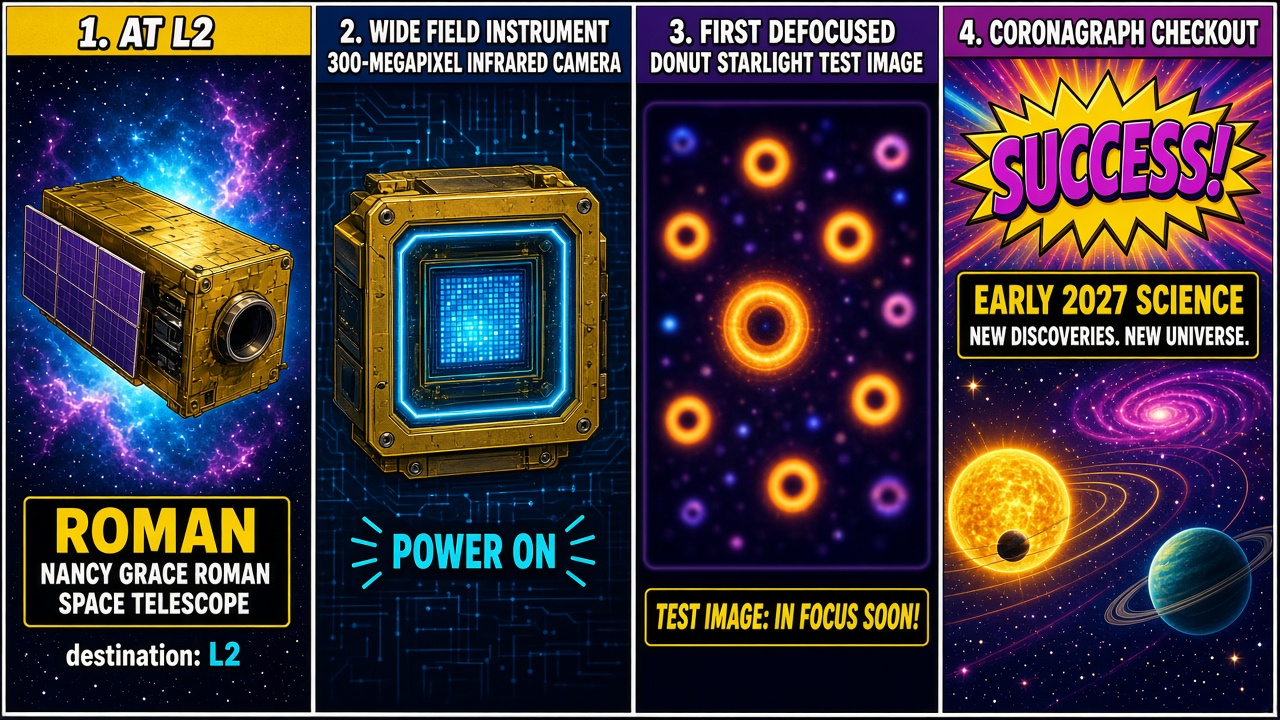
NASA’s Ashley Balzer, dated September 15, 2026, reports that the Nancy Grace Roman Space Telescope has activated its primary science camera — the Wide Field Instrument, a 300-megapixel infrared imager — while still en route to Sun-Earth Lagrange Point 2. The mission also began initial checkout of the Coronagraph Instrument after waking it earlier this month. That is the Science filing: a dated instrument-activation stamp, not a first-light science gallery yet.
The Wide Field Instrument rested about 10 days after launch-era procedures; on Sept. 11 teams turned heaters off so the instrument could cool toward roughly −225°F before activating its 18 infrared detectors, then ran calibration, exercised the element wheel, and worked the focus mechanism over the weekend as detectors headed toward about −300°F. The first starlight test image shows out-of-focus “donut” stars because the detector array is still stowed from launch; first science images are expected in early 2027. Separately, the Coronagraph Commanding Center at Caltech/IPAC confirmed communication, with thermal conditions near 72°F ahead of a planned 30-day decontamination period. Coverage quotes Josh Schlieder, Wide Field Instrument scientist at NASA’s Goddard Space Flight Center, and Eric Cady of JPL. Bright Roman gold and deep-space indigo. White gutters.
A mid-cruise primary-instrument activation with a transparent “donuts, not science yet” first image is a clean Science slot. Readers get Balzer’s Sept. 15 NASA stamp, the 300-megapixel WFI wake-up, the Sept. 11 heater-off cool-down path to −225°F then ~−300°F, the 18 IR detectors, element wheel and focus work, the out-of-focus donut starlight test with the array still stowed, early-2027 science-image timing, coronagraph checkout via Caltech/IPAC, ~72°F thermal, and the 30-day decontamination note — not a rewrite of every Roman design paper. If panels invent fully focused deep-field glory the release does not claim, verified prose wins.
Why it matters
Readers get the instrument (Roman WFI), the 300-megapixel IR camera activation still en route to L2, the cooldown and detector timeline, the honest out-of-focus first starlight donuts, early-2027 science-image expectations, and the coronagraph’s Caltech/IPAC checkout with ~72°F thermal and 30-day decontamination. Keep politics out. Keep the NASA URL on the page. Bright telescope gold and infrared cyan. White gutters. Waking the primary camera mid-cruise is the strip — commissioning, not a finished sky survey.
Conclusion
NASA’s Sept. 15 Balzer update reports that Roman activated its 300-megapixel Wide Field Instrument after a Sept. 11 heater-off cooldown toward roughly −225°F and detector work toward ~−300°F, captured a first out-of-focus donut starlight test with the array still stowed, expects first science images in early 2027, and confirmed coronagraph communication from Caltech/IPAC at about 72°F ahead of 30-day decontamination, with quotes from Josh Schlieder (Goddard) and Eric Cady (JPL), while the observatory remains en route to L2. Source: https://science.nasa.gov/blogs/roman/2026/09/15/nasa-activates-romans-primary-instrument-checks-out-coronagraph/
Source: NASA