
Science and Space
Simulations: planetesimals could form from Pop III supernova leftovers
What happened
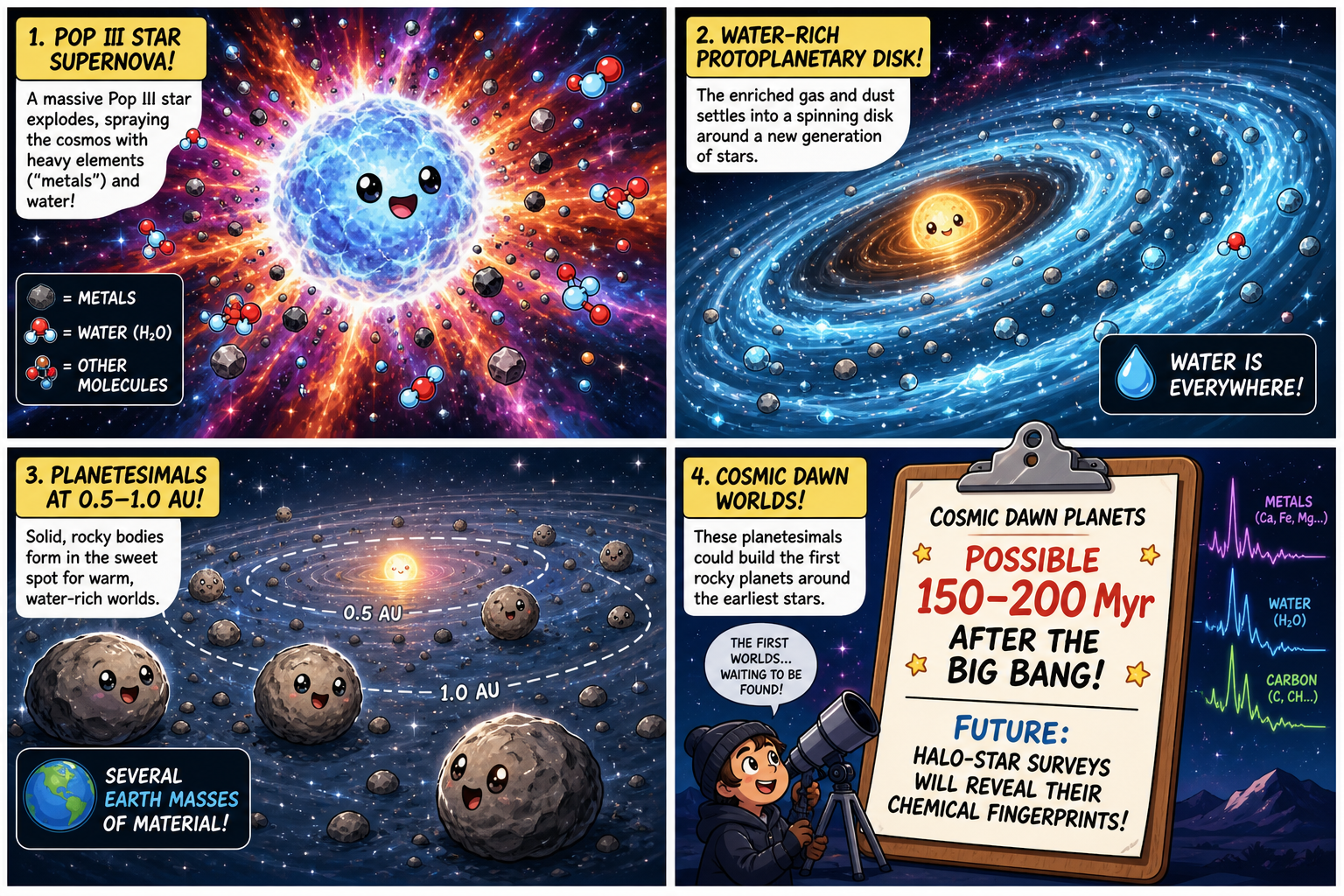
AAS Nova, dated 2 September 2026, recaps an Astrophysical Journal Letters paper by Eduard I. Vorobyov and collaborators: Planet Formation at Cosmic Dawn: Planetesimals in H2O-rich Disks around Low-mass Stars. The first stars, Population III, formed from nearly pristine hydrogen and helium. They burned fast and died in pair-instability supernovae that shredded the progenitors and dumped more than 100 solar masses of metals into their surroundings. Cosmological simulations had already hinted that oxygen from those blasts could leave water-rich dense cores in the remnants. The new work asks whether those cores can actually assemble planetesimals — the building blocks of rocky planets — around the next generation of stars.
The team simulated the collapse of a one-solar-mass gas cloud core. A protostar appears about 24 thousand years after collapse begins. A rotating disk grows around a roughly 0.4-solar-mass star. Tracking gas and dust, the authors find several Earth masses of planetesimals forming between 0.5 and 1.0 astronomical units. The run does not follow the disk all the way to finished planets; that would need heavier multi-body modeling. It does show enough planetesimals to build a Mars- or Earth-mass world later. Low-mass stars born this way would still be burning hydrogen today, so ancient metal-poor halo stars could host some of the universe’s earliest planets for future surveys to find.
That timeline is the headline shift. Prior pictures of planet formation often waited billions of years for enough metals to pile up. This study argues water-rich disks with planetesimals could appear as early as 150 to 200 million years after the Big Bang — billions of years earlier than the slow-trickle story. The comic is the supernova spray, the wet disk, the rocky pebbles at 0.5–1 AU, and a clipboard stamped cosmic dawn.
Why it matters
Science on this desk is a dated paper with a clear claim, not a habitability sermon. The claim is early planetesimals from Pop III leftovers. Not yesterday’s Makani PAH winds. New simulation, new clock. Readers get the water, the AU range, and the 150–200 Myr window without a lecture on life.
Conclusion
Vorobyov et al., recapped by AAS Nova on Sept. 2, find several Earth masses of planetesimals in a water-rich disk that could form 150–200 million years after the Big Bang. Source: https://aasnova.org/2026/09/02/primordial-planetesimals-from-the-guts-of-population-iii-stars/
Source: AAS Nova