
Science and Space
Pandora starts staring at exoplanets and their stars
What happened
NASA’s Pandora mission has started science. The Aug. 25 NASA Science story by Francis Reddy, last updated Aug. 27, says the small satellite — the first to launch through the agency’s Astrophysics Pioneers program — is now making observations of exoplanets and the stars they orbit. The job, as NASA prints it, is to determine the atmospheric make-up of at least 20 exoplanets, including hazes, clouds, and water. Jordan Karburn, deputy project manager at Lawrence Livermore National Laboratory, said the spacecraft is healthy, the instruments are performing, and commissioning work is done: “we can now confidently start science.”
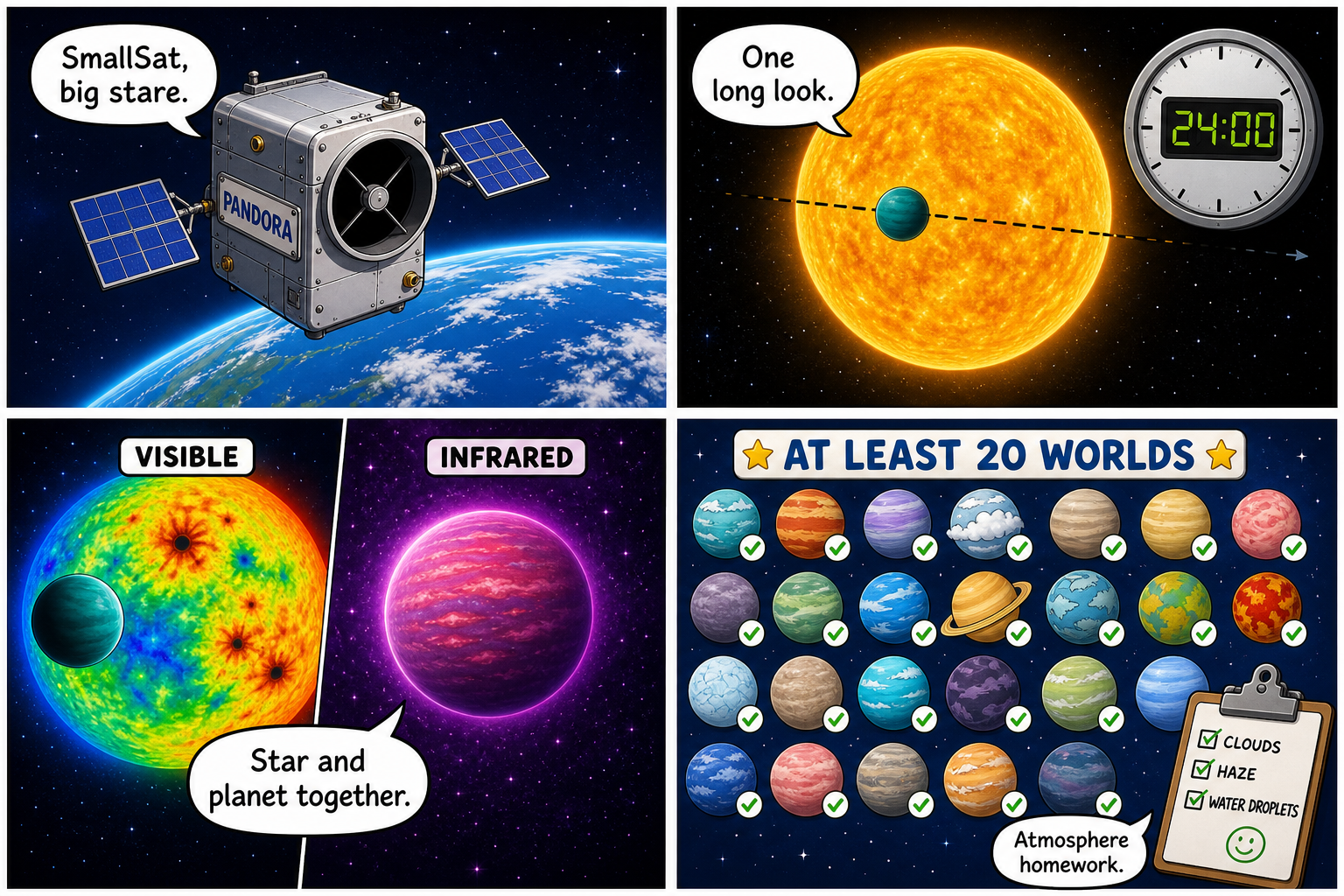
Pandora left for low Earth orbit on Jan. 11. Pioneers are the fast, low-cost class with a higher-than-usual tolerance for failure. Three design choices are what NASA calls unique: an all-aluminum telescope about 18 inches (45 centimeters) across, jointly developed by Livermore and Corning; the ability to study a planet and its host star at the same time in visible and infrared light; and stares much longer than flagship observatories can usually spare. The near-infrared detector is a spare originally built for the James Webb Space Telescope. Over a year-long primary mission, Pandora will observe at least 20 exoplanets 10 times each, with a long-duration stare covering 24 hours and a transit inside each look.
The science problem is a lighting trick. When a planet crosses its star, some starlight skims the planet’s air and picks up chemical fingerprints. Instruments also see the whole star, and stellar surfaces are blotchy: hotter faculae, cooler spot-like regions, all of it sliding as the star rotates. Elisa Quintana, principal investigator at Goddard, said astronomers currently “can’t be entirely sure how the star’s light affects measurements of what makes up exoplanet atmospheres.” MIT’s Benjamin Rackham named water as one of the most important molecules and the one stellar features can distort. Pandora’s detectors take the star’s visible brightness and near-infrared spectrum together, plus a near-infrared spectrum of the planet during transit, so the two signals can be pulled apart.
Why it matters
Webb is the famous spectrograph in this neighborhood. Pandora is the long stare that Webb cannot book every week. Knicole Colón, project scientist at Goddard, said combining the two data sets should let scientists map stellar surfaces and “cleanly separate star and planetary signals.” That is not a habitability press conference. It is homework that makes later Webb atmospheres less likely to be a star wearing a planet costume. NASA is explicit that the results are meant to ground interpretations for Webb and for future observatories hunting habitable worlds. The 20-planet, 10-visit, 24-hour pattern is the method, not a tease about life.
Goddard leads the mission. Livermore provides project management and engineering. Blue Canyon Technologies built the bus. Ames processes the data. The University of Arizona leads mission operations. Science products go to the NASA Exoplanet Archive at IPAC. Those names are the credit block. The comic is the little aluminum telescope, the 24-hour clock, the visible/infrared split, and a checklist that still says clouds, haze, and water — the three things NASA named in the lede.
Conclusion
Pandora is in science mode, a SmallSat with an 18-inch aluminum telescope, staring at transits for 24 hours at a time so a star’s freckles do not get filed as a planet’s weather. At least 20 worlds, ten visits each, visible plus infrared, a Webb spare in the detector bay. NASA Science published the start-of-science note on Aug. 25. The strip is orbit, stare, split spectrum, checklist. Source: https://science.nasa.gov/missions/pandora-missions/nasas-pandora-mission-begins-study-of-exoplanets-host-stars/
Source: NASA Science