
Science and Space
NASA-IBM Lunar Foundation Model opens on Hugging Face and GitHub
What happened
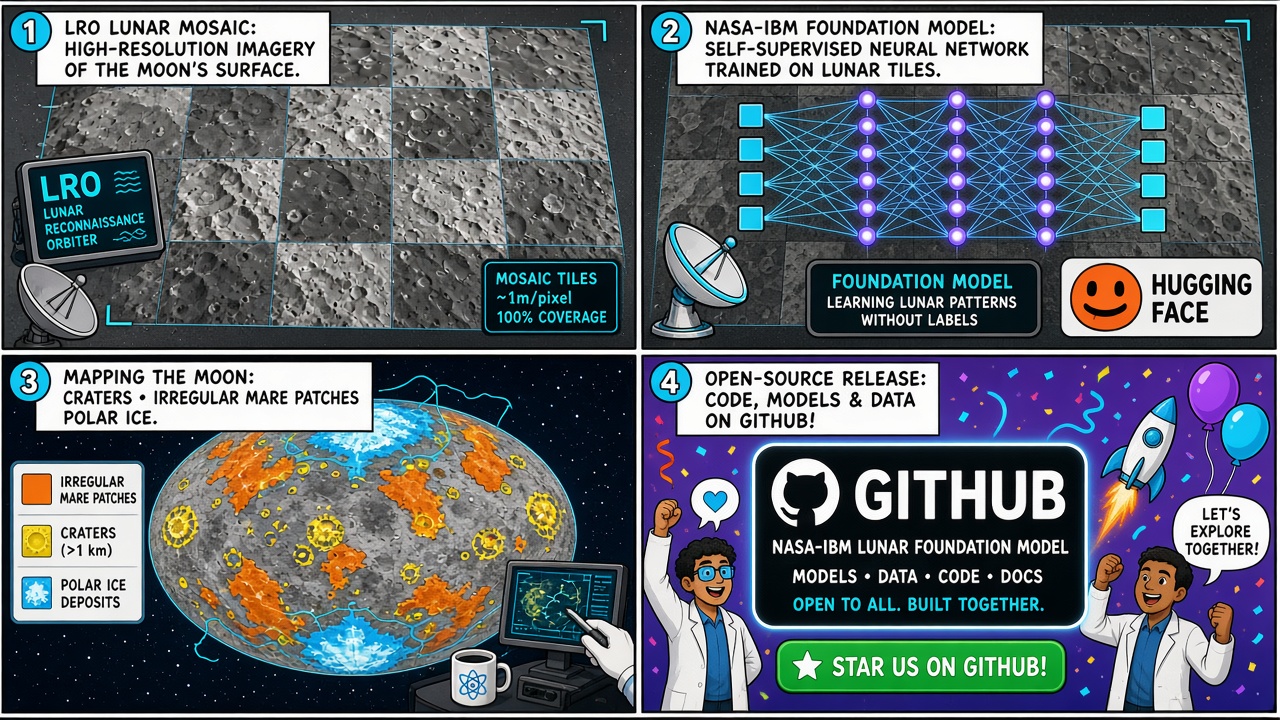
NASA Science, dated September 10, 2026, reports the launch of the NASA-IBM Lunar Foundation Model — among the first open-source AI foundation models built specifically for lunar science. The model is hosted publicly on Hugging Face with the complete codebase on GitHub. It was trained primarily on data from NASA’s Lunar Reconnaissance Orbiter (LRO), using roughly 2 million image tiles (more than 1 million high-resolution camera images at 1-meter resolution and nearly 964,000 multispectral images at 100-meter resolution), plus terrain and imagery from missions such as GRAIL, Lunar Prospector, and JAXA’s SELENE.
Researchers can fine-tune the pre-trained model for tasks including crater mapping, spotting young volcanic features known as irregular mare patches, and estimating where ice may be stable near the lunar poles — including permanently shadowed regions. NASA Science frames the release as open science: machine learning-ready pre-training datasets and benchmarks ship alongside the model, which is integrated into the open-source TerraTorch toolkit. Ignore wrong training counts or closed-source claims that may appear inside comic art; the verified filing is ~2M LRO tiles, Hugging Face + GitHub, open release.
A dated open-model drop with named lunar tasks is a clean Science slot. Readers get the Sept. 10 stamp, NASA-IBM collaboration, ~2M LRO tiles, Hugging Face and GitHub hosting, crater mapping, irregular mare patches, polar ice prospectivity, and the open-science framing — not a rewrite of every baseline comparison in the companion paper.
Why it matters
Readers get the instrument heritage (LRO-led training), the ~2 million tile count, the public Hugging Face and GitHub release, and the three headline adaptation tasks: craters, irregular mare patches, and polar ice prospectivity. Keep politics out. Keep the NASA Science URL on the page. Bright lunar gray and ice-cyan. White gutters. An open foundation model with a receipt is the strip.
Conclusion
NASA and IBM’s Lunar Foundation Model, announced Sept. 10 via NASA Science, is open on Hugging Face and GitHub after training on roughly 2 million LRO tiles — supporting crater mapping, irregular mare patch detection, and polar ice prospectivity as open science. Source: https://science.nasa.gov/science-research/artificial-intelligence-lunar-foundation-model/
Source: NASA Science