
Science and Space
JWST finds hitchhiking dust 100,000 light-years outside Makani
What happened
AAS Nova, dated 1 September 2026, recaps a new Astrophysical Journal paper led by Sylvain Veilleux at the University of Maryland: JWST Discovery of Warm Dust in the Circumgalactic Medium of the Makani Galaxy. Makani, Hawaiian for “wind,” is a record-breaking outflow galaxy found in 2019 with Keck. A merger triggered waves of star formation. An active black hole and supernovae from those bursts both help drive winds that stretch about 100 kiloparsecs, or 330,000 light-years, beyond the galaxy — roughly ten times a typical galactic wind. The new JWST result is not the wind itself. It is what is riding it.
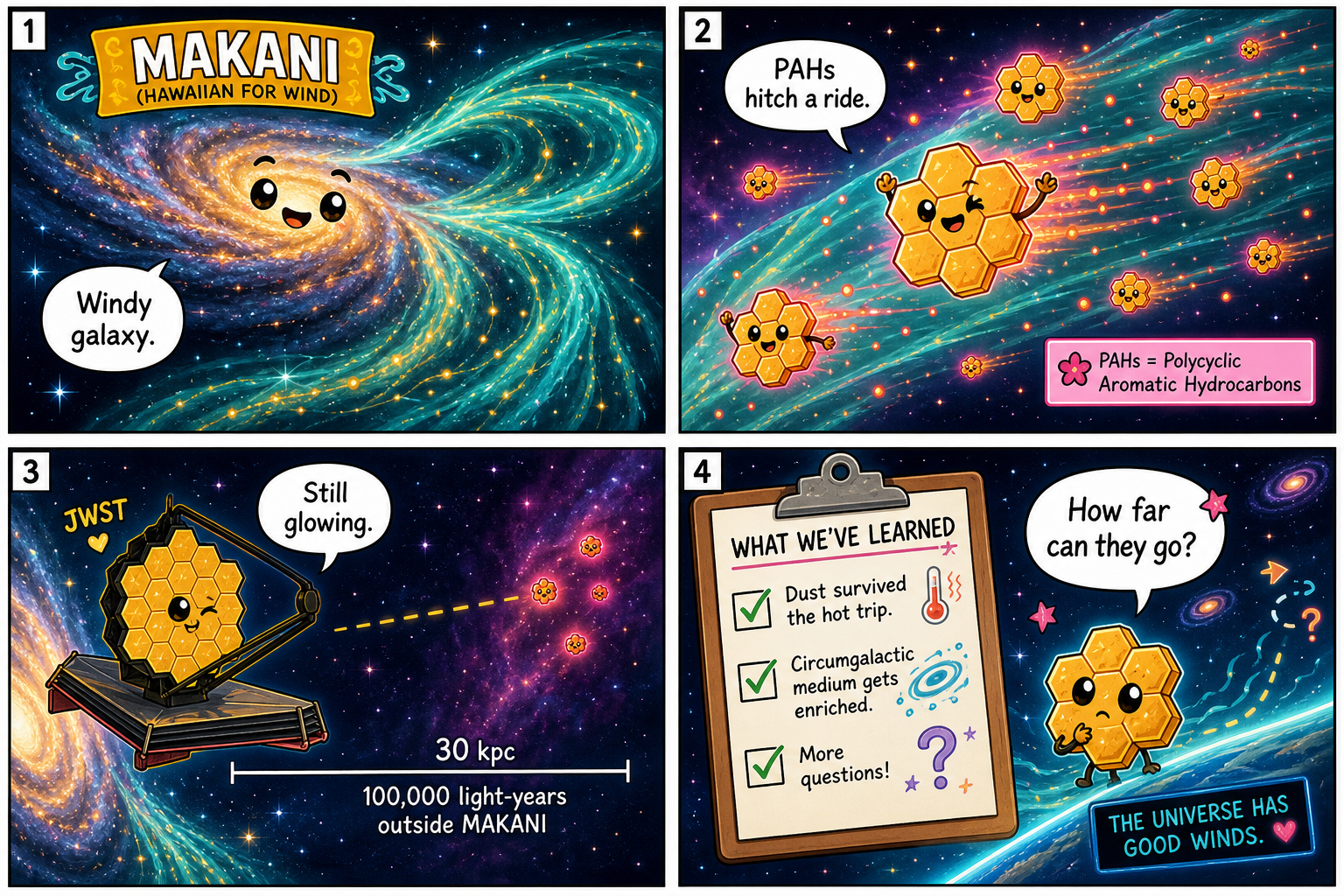
Polycyclic aromatic hydrocarbons, PAHs, are small, flat dust grains. They show up in exhaust and wildfire smoke on Earth and, in infrared, across the universe. They help regulate temperatures in the interstellar medium, and astronomers have wondered how they migrate. Even though each grain is smaller than a human hair, enough of them glow in JWST filters to map. In Makani’s redshift, known PAH features land neatly in those bands. Veilleux’s team found PAHs not only inside the galaxy but up to about 30 kpc, or 100,000 light-years, outside it. The paper estimates the winds have been ejecting that dust on a timescale of about a billion years.
That location is the surprise. Astronomers had not expected high quantities of dust grains to survive the trip through gas that can be millions of degrees, a ride that high-energy photons should shred. The detection implies the PAHs were shielded in large enough volumes to make it past the galaxy’s edge. The team could not yet tell whether PAHs fill Makani’s entire 100-kpc wind or only the inner 30–35 kpc their sensitivity reached. They would like to look even farther, into the intergalactic medium, to see if the hitchhikers go the distance.
Why it matters
Galactic winds strip gas and help enrich the circumgalactic medium, the mostly empty space around a galaxy. Finding warm dust out there is a concrete way that enrichment happens: not just atoms, but molecules that still look like PAHs after a brutal commute. This is not a habitability story and not yesterday’s Pandora exoplanet stares. It is a map of how a windy galaxy seasons its neighborhood. The comic is a spiral blowing, honeycomb grains catching a ride, a gold telescope at 30 kpc, and a clipboard that still has more questions.
The paper does not claim the grains are indestructible. It claims they are there, glowing, far outside the disk, which means something protected them. That is the filing. JWST’s infrared eye made a classroom molecule into a galactic traveler.
Conclusion
JWST spotted PAH dust up to 100,000 light-years outside Makani, riding one of the strongest galactic winds on the books. Veilleux et al. in ApJ, recapped by AAS Nova on Sept. 1. The strip is the windy galaxy, the hitchhikers, the 30 kpc ruler, and a checklist that ends on how far they can go. Source: https://aasnova.org/2026/09/01/hitchhiking-pahs-caught-catching-a-ride-on-galactic-winds/
Source: AAS Nova