
Science and Space
Hubble and Webb find tiny TNOs that still ‘remember’ their past
What happened
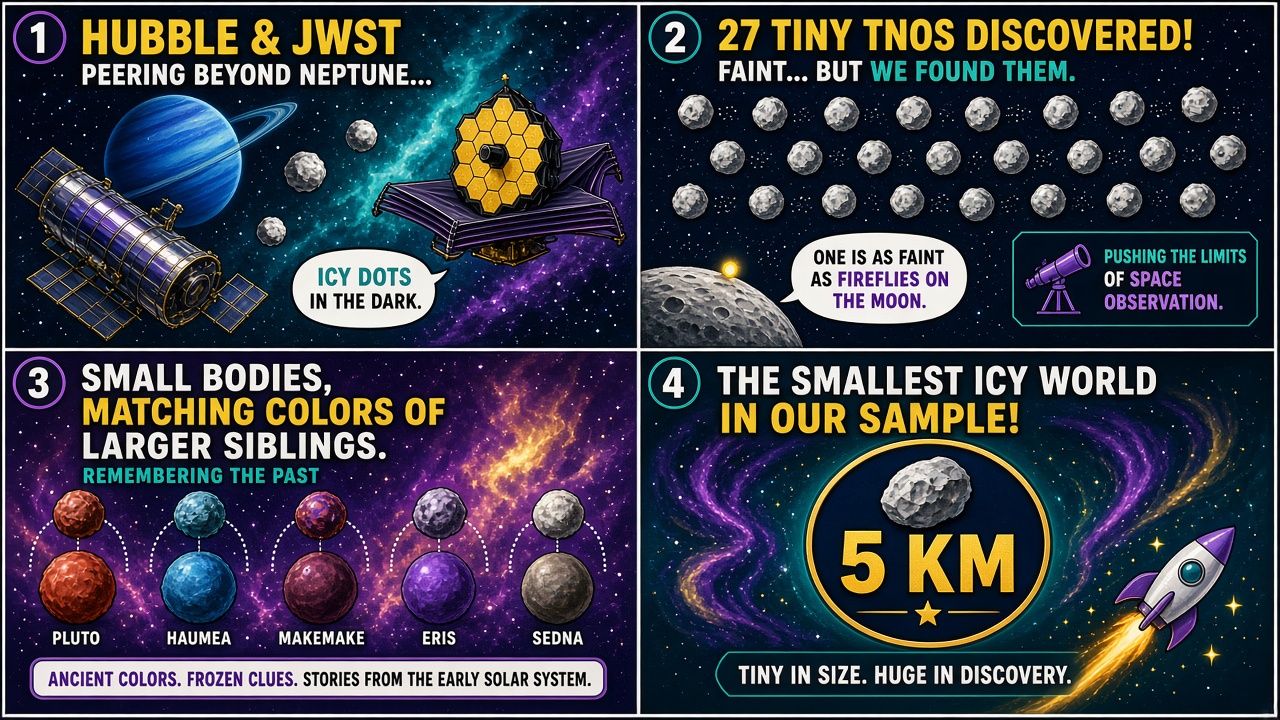
NASA’s Sept. 8 release reports the first joint Hubble–Webb survey of far-out Trans-Neptunian Objects, with two complementary papers in The Astronomical Journal. Teams measured color, composition, size, and orbits for 27 newly discovered tiny, dim TNOs — some of the smallest and faintest ever directly seen. Hubble watched visible light while Webb watched infrared on the same sky patch. One object is so faint NASA likens it to standing on Earth and seeing a small swarm of fireflies on the Moon. The smallest observed is about 5 kilometers across, or roughly 3 miles — about five times smaller than the best ground-based detections can reach.
Dynamically “cold” TNOs stay on quieter, more circular orbits near the solar-system plane. Dynamically “hot” TNOs ride more elliptical paths after early giant-planet migration scrambled them. Astronomers expected collisions to rewrite the surfaces of the tiniest bodies compared with larger siblings. Instead, both populations keep colors like their larger family members — a “memory” of how they formed. Size distributions for hot and cold groups look surprisingly similar, and researchers found fewer of these very small bodies than some planet-formation models predicted.
Science packages here prefer a measurable survey over a press-release adjective. Twin telescopes, 27 new dots, sibling colors, and a firefly-on-the-Moon badge make the strip. Bright teal and ice-blue. White gutters. Not a claim that every model is wrong — a report that the count came in light.
Why it matters
Readers get the instrument pairing, the AJ papers, the 27 discoveries, the ~5 km floor, and the cold/hot color continuity. Keep politics out. Keep the NASA URL on the page. A frozen planetesimal census beyond Neptune is a clean Science slot: dated, sourced, and free of hype.
Conclusion
Hubble and Webb together found 27 tiny TNOs that keep sibling colors and arrive in fewer numbers than some models expected, per NASA’s Sept. 8 release. Source: https://science.nasa.gov/missions/hubble/nasas-hubble-webb-find-far-out-solar-system-objects-remember-past/
Source: NASA