
Science and Space
JWST rules out tiny exomoons around rocky temperate LP 890-9c
What happened
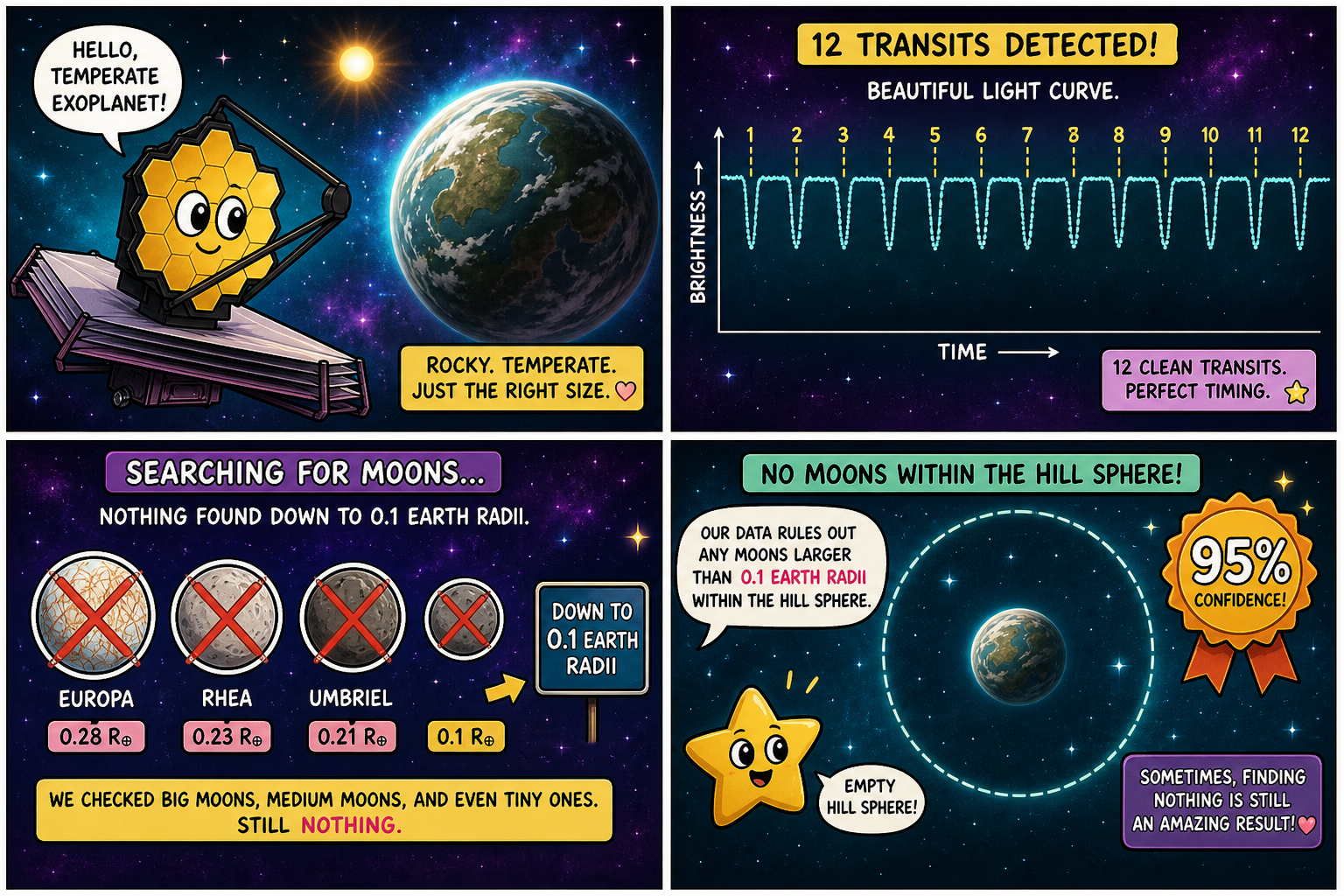
arXiv paper 2609.05301, submitted 4 September 2026 by David Kipping and accepted in the Astronomical Journal, reports a JWST search for exomoons around the rocky, temperate-zone exoplanet LP 890-9c. The team used twelve JWST transits rather than a single event. They find no evidence for an exomoon, but they exclude moons as small as 0.1 Earth radii to 95% confidence across the entire Hill region — by far the most sensitive bound-planet exomoon search to date.
Those limits rule out analogs to many real Solar System moons such as Europa, Rhea, and Umbriel. The paper also notes that LP 890-9c’s close-in orbit at about 0.04 au would make moons larger than roughly 0.1 Earth radii unlikely to survive for many gigayears because of tides. Even a single clean transit can deliver strong limits; one noisy epoch recovers when paired with a cleaner one. This desk files the null result as a science win: sensitivity, not a claimed discovery of a moon.
Why it matters
Science packages here prefer a measurable sample over a press-release adjective. Twelve transits and a 0.1-Earth-radius exclusion contour is the strip: JWST staring at a temperate rock, a light curve with twelve dips, crossed-out moon stickers, and an empty Hill sphere with a 95% badge. Bright teal and purple. White gutters. Not a how-to for building a telescope and not a claim that Earth is unique or doomed.
Null results that push sensitivity still move the field. Readers get the planet name, the transit count, the radius floor, and the arXiv path. Keep politics out. Keep the source URL on the page.
Conclusion
JWST’s twelve-transit look at LP 890-9c finds no exomoon and excludes 0.1-Earth-radius moons across the Hill region at 95% confidence, per arXiv 2609.05301. Source: https://arxiv.org/abs/2609.05301
Source: arXiv