
Science and Space
JWST watches planet-forming disks race the clock
What happened
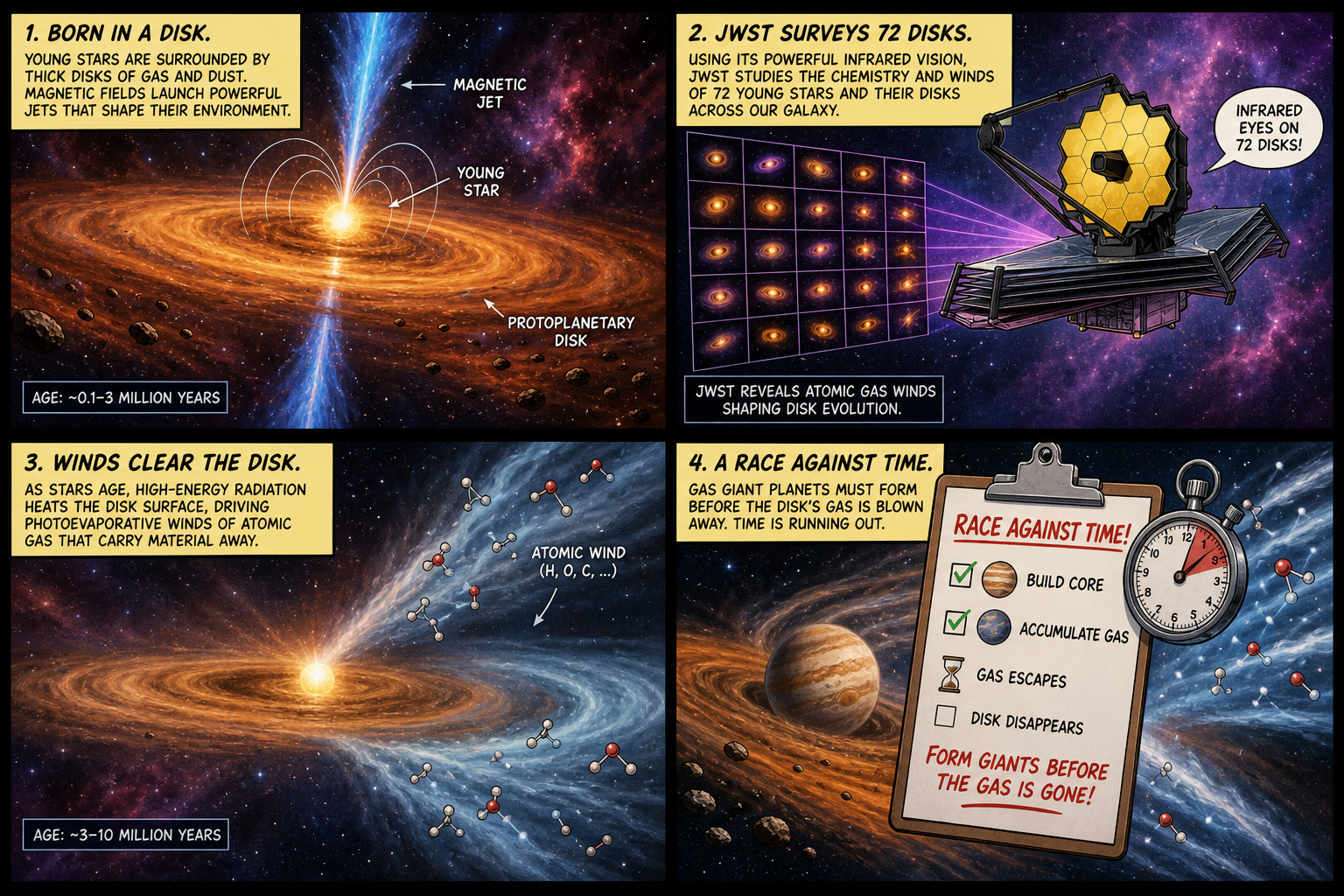
Scientific Inquirer, dated 2 September 2026, covers a new Astronomical Journal paper led by Naman Bajaj and collaborators on JWST observations of 72 protoplanetary disks. The work frames planet formation as a race against disk dispersal. Early magnetic jets clear inner material; later ultraviolet-driven photoevaporative winds take over and can starve the midplane of gas before giant planets finish growing. The sample lets the team map when jets fade and winds rise across disk ages and masses.
JWST’s mid-infrared spectroscopy is what makes the wind tracers readable in this batch of disks. Lines that ground telescopes struggle to separate show up cleanly enough to sort jet-dominated systems from wind-dominated ones. The paper’s takeaway is temporal: the clock is not infinite, and the wind phase can end the feeding window. This desk files the race metaphor, the 72-disk sample, and the magnetic-to-photoevaporative handoff as Science — dated, sourced, no hype about aliens.
Why it matters
Science packages here prefer a measurable sample over a press-release adjective. Seventy-two disks and a clear jet-then-wind sequence is the strip: a baby planet racing a clock, a magnetic jet, a UV wind broom, and an hourglass over the midplane. Bright nebula colors. White gutters. Not a how-to for building a telescope and not a claim that Earth is unique or doomed.
Planet-forming disks are the setting where “race against time” is literal gas physics. Readers get the handoff story and the AJ citation path through the Inquirer write-up. Keep politics out. Keep the source URL on the page.
Conclusion
JWST’s look at 72 disks shows magnetic jets giving way to photoevaporative winds that can cut planet-building short, per Bajaj et al. as reported by Scientific Inquirer. Source: https://scientificinquirer.com/2026/09/02/jwst-reveals-a-race-against-time-for-forming-planets/
Source: Scientific Inquirer