
Science and Space
JWST occultation shows Chariklo’s two rings are changing
What happened
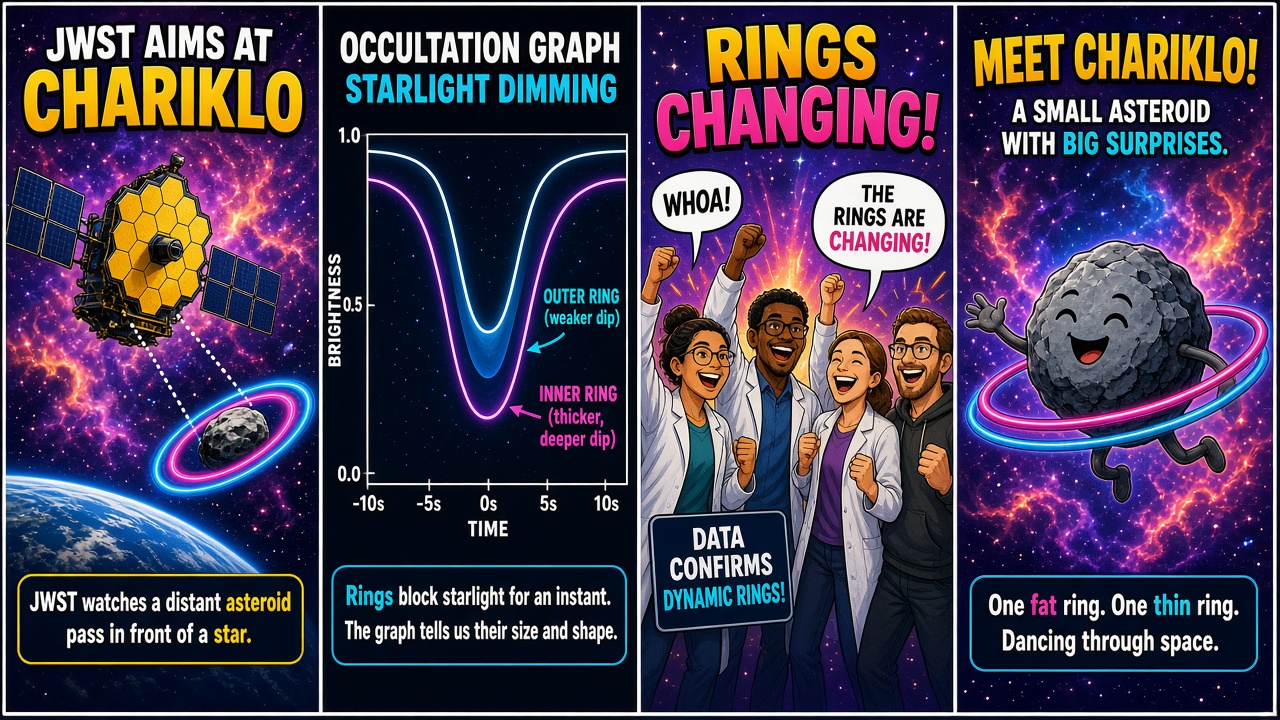
Space.com, covering a Science Advances paper published September 9, 2026, reports that the James Webb Space Telescope’s first planned stellar occultation showed Chariklo’s two rings are changing. Chariklo is a Centaur orbiting between Saturn and Uranus and only about 250 kilometers (roughly 155 miles) across, yet it hosts two thick rings first discovered in 2013. A team led by researchers at Spain’s Institute of Astrophysics of Andalusia (IAA-CSIC) compared the JWST occultation with a decade of earlier occultations and found opposite trends: the inner ring is significantly more opaque (denser), while the outer ring shows a weaker near-infrared signature (lower opacity).
Stellar occultation measures the dip in starlight when a body and its rings pass in front of a background star. Precise geometry required Chariklo’s orbit, the star’s position from ESA’s Gaia mission, and JWST’s path around the Sun-Earth L2 point. The cartoon is illustrative if panels compress ring physics into a single diagram; verified prose sticks to the two-ring change, the ~250 km Centaur, the first planned JWST stellar occultation, Gaia’s star fix, and the IAA-CSIC lead. Bright JWST gold and ice-cyan. White gutters. Ignore wrong diameters or “third ring” slogans that may appear inside comic art.
A dated occultation result with named instruments and a measured ring change is a clean Science slot. Readers get the Sept. 9 Science Advances stamp, JWST’s first planned stellar occultation, Chariklo’s two rings evolving in opposite directions, the Centaur’s ~250 km scale between Saturn and Uranus, Gaia’s contribution, and the IAA-CSIC team — not a rewrite of every prior 2013 discovery paper.
Why it matters
Readers get the instrument (JWST occultation plus Gaia), the ~250 km Centaur between Saturn and Uranus, the inner-denser / outer-weaker ring contrast, the first planned JWST stellar occultation milestone, and the IAA-CSIC lead. Keep politics out. Keep the Space.com URL on the page. Bright ring dust and telescope gold. White gutters. Changing rings on a tiny body force a rethink of how small-body rings form and stay stable — that is the strip.
Conclusion
JWST’s first planned stellar occultation, reported via Space.com from a Sept. 9 Science Advances study led by IAA-CSIC, shows Chariklo’s two rings changing — inner denser and more opaque, outer weaker in the near-infrared — around the ~250 km Centaur between Saturn and Uranus, with Gaia supplying the star position. Source: https://www.space.com/astronomy/james-webb-space-telescope/james-webb-space-telescope-discovers-the-rings-of-tiny-solar-system-body-chariklo-are-changing
Source: Space.com