
Science and Space
JWST flags a candidate black-hole binary in dusty AzTEC-1
What happened
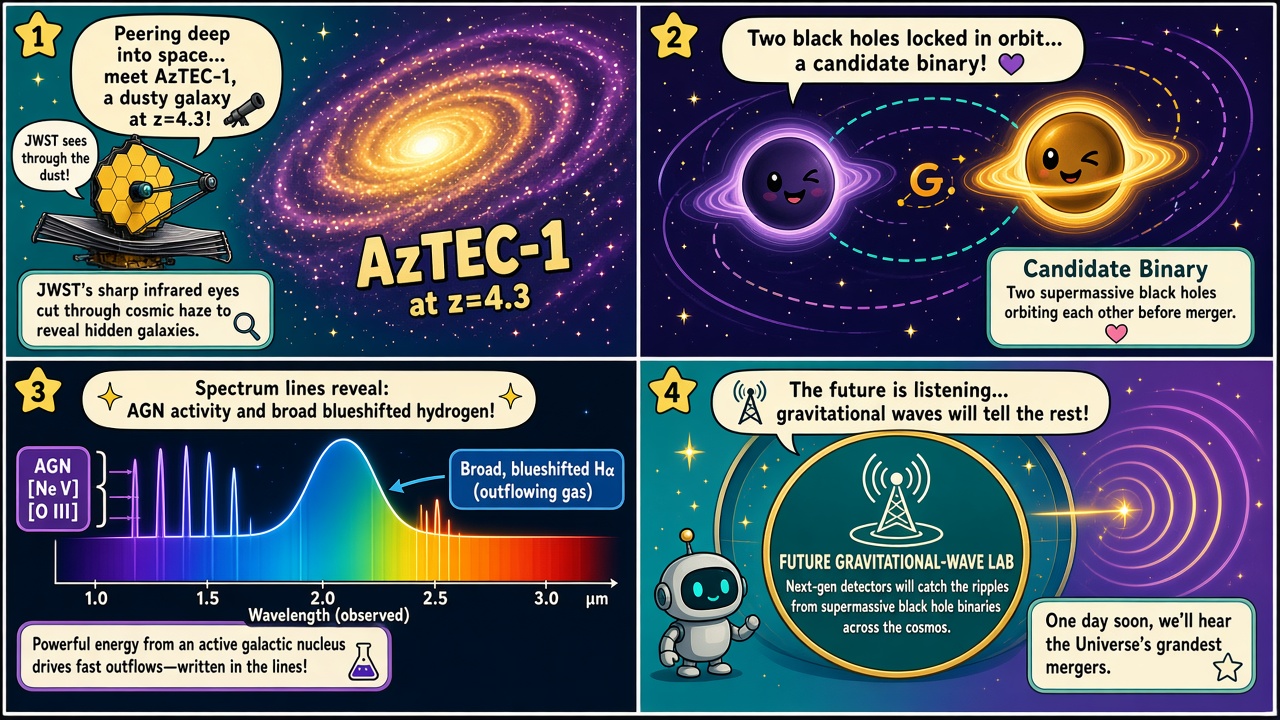
arXiv paper 2609.01711, submitted 1 September 2026 by Jed McKinney and collaborators, presents JWST/NIRSpec PRISM and G395M spectroscopy of AzTEC-1, a massive sub-millimeter-bright galaxy at redshift 4.3 in the COSMOS field. The PRISM spectrum shows a young stellar population and high dust attenuation. BPT line ratios indicate an active galactic nucleus. Decomposing narrow and broad components recovers broad, blueshifted hydrogen that the authors read as a possible second black hole’s broad-line region.
AzTEC-1’s smooth morphology and stellar age suggest a past merger-induced starburst that could have delivered a second supermassive black hole, raising the binary candidacy. The team does not find clear evidence for an extended outflow in the 2D spectrum, NIRCam imaging, or resolved ALMA dust and gas kinematics. High central gas density may help stall the final inspiral on million-year timescales. If confirmed, AzTEC-1 would be a laboratory for the astrophysics behind low-frequency gravitational-wave detections. This desk files a candidate, not a confirmed merger.
Why it matters
Science packages here prefer a measurable spectrum over a press-release adjective. A dusty z=4.3 galaxy with AGN fingerprints and a binary hypothesis is the strip: JWST through the dust, twin black-hole icons, blueshifted lines, and a future GW badge. Bright teal and gold. White gutters. Not a claim that the waves have already been heard.
Readers get the galaxy name, the redshift, the instrument, and the arXiv path. Keep politics out. Keep the source URL on the page.
Conclusion
JWST spectroscopy of AzTEC-1 at z=4.3 raises a candidate supermassive black hole binary after a past merger, per arXiv 2609.01711. Source: https://arxiv.org/abs/2609.01711
Source: arXiv