
Science and Space
Hubble and Webb find 27 tiny TNOs that still ‘remember’ the past
What happened
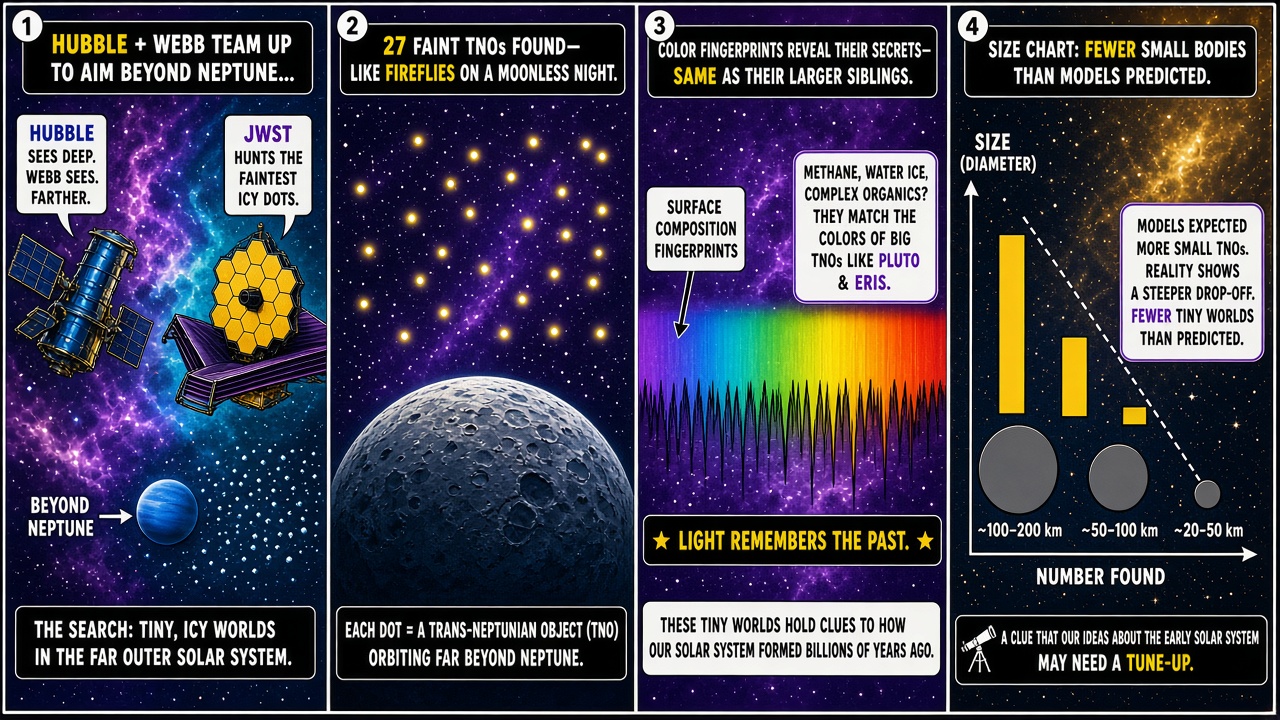
NASA Science, dated September 8, 2026, reports that scientists used NASA’s Hubble and James Webb Space Telescopes together to study Trans-Neptunian Objects (TNOs) — small, faint, icy bodies orbiting beyond Neptune — and analyzed 27 newly discovered tiny, dim TNOs in two complementary papers published in The Astronomical Journal. Teams unexpectedly found fewer small TNOs than some planet-formation models predicted, and the colors of these bodies followed the same relationships as their larger family members — a “remember the past” result that suggests the smallest objects somehow preserve how they were made.
In the deepest TNO survey to date, teams led by PhD candidates from the University of Victoria (under National Research Council of Canada guidance) and Northern Arizona University examined a patch of sky simultaneously with Hubble in visible light and Webb in infrared, measuring colors, sizes, and orbits for both dynamically “cold” and “hot” TNO populations. Webb discovered 27 new, remarkably dim TNOs; one is so faint it is compared to standing on Earth and seeing a small swarm of fireflies on the Moon. The smallest observed has a diameter of about 3 miles (5 kilometers). The cartoon is illustrative if panels invent named ices or dwarf-planet slogans the release does not pin to these 27; verified prose sticks to the joint Hubble+Webb survey, the 27 new TNOs, colors matching larger siblings, fewer small bodies than models, the ~3 miles / 5 km smallest, the fireflies-on-the-Moon faintness line, and the two Astronomical Journal papers. Bright JWST gold and deep-space cyan. White gutters.
A dated multi-telescope result with measured size and color trends is a clean Science slot. Readers get the Sept. 8 NASA stamp, Hubble visible plus Webb infrared, 27 new tiny TNOs, the remember-past color match, the shortfall versus models, the ~5 km floor, and the firefly faintness metaphor — not a rewrite of every prior Kuiper Belt catalog paper.
Why it matters
Readers get the instruments (Hubble + Webb), the 27 new faint TNOs, colors that match larger siblings, fewer small bodies than models expected, the smallest at about 3 miles / 5 km, and the two Astronomical Journal papers. Keep politics out. Keep the NASA Science URL on the page. Bright icy dots and telescope gold. White gutters. Tiny worlds that still look like their bigger siblings force a rethink of collision and planetesimal-formation stories — that is the strip.
Conclusion
NASA’s Sept. 8 release on a joint Hubble–Webb survey reports 27 newly discovered tiny Trans-Neptunian Objects whose colors match larger siblings, with fewer small bodies than some models predicted, the faintest compared to fireflies on the Moon, and the smallest about 3 miles (5 km) across, in two Astronomical Journal papers. Source: https://science.nasa.gov/missions/hubble/nasas-hubble-webb-find-far-out-solar-system-objects-remember-past/
Source: NASA Science