
Science and Space
Chandra finds 84 hypersoft X-ray sources across six galaxies
What happened
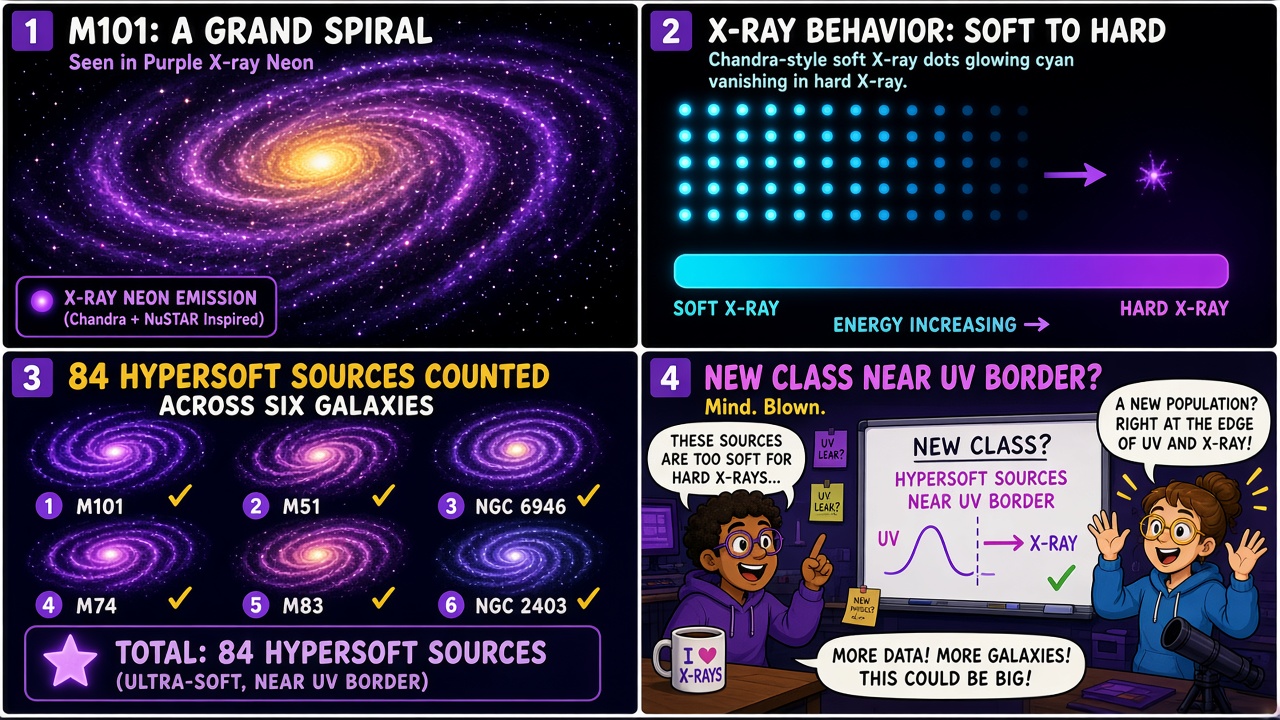
NASA’s Chandra X-ray Observatory archive work, reported via NASA Science, identifies 84 “hypersoft X-ray sources” across six galaxies: the spirals M31 (Andromeda) and M101 (Pinwheel) plus four ellipticals. The sources appear in the lowest-energy X-ray images and vanish in higher-energy bands, while producing intense ultraviolet emission near the soft-X-ray border of the spectrum. The result is published in Nature Astronomy. Ignore wrong galaxy names that may be drawn inside the comic art; the verified set is M31, M101, and four ellipticals.
Astronomers suggest these objects may be binaries powered by black holes, neutron stars, or white dwarfs, and that their ultraviolet output could relate to Type Ia supernova progenitor pathways and to ionization of galactic gas — long-standing open questions the team flags as possible connections, not settled claims. Science packages here prefer a countable sample and an energy behavior over a press-release adjective. Bright purple X-ray neon and cyan soft-band glow. White gutters.
A class that only shows up at the softest Chandra energies is a clean Science slot: dated, sourced, and free of hype. Readers get the 84-source count, the six-galaxy span, the soft-appear / hard-vanish signature, the intense UV note, and the Nature Astronomy tag — not a rewrite of every binary model.
Why it matters
Readers get the instrument (Chandra archive), the 84 hypersoft sources, M31 and M101 plus four ellipticals, the lowest-energy visibility that disappears higher up, the intense UV, possible BH/NS/WD binary interpretations, and possible links to Type Ia progenitors and galactic gas ionization. Keep politics out. Keep the NASA Science URL on the page. Soft-band mystery dots with a receipt are the strip.
Conclusion
Chandra’s archive yields 84 hypersoft X-ray sources in M31, M101, and four ellipticals — visible at the lowest energies, gone higher up, bright in UV — with Nature Astronomy reporting possible binary origins and links to Type Ia progenitors and galactic ionization. Source: https://science.nasa.gov/missions/chandra/nasas-chandra-unveils-mysterious-x-ray-objects/
Source: NASA Science