
Science and Space
A bus-sized telescope just left Florida to hunt a hidden sky
What happened
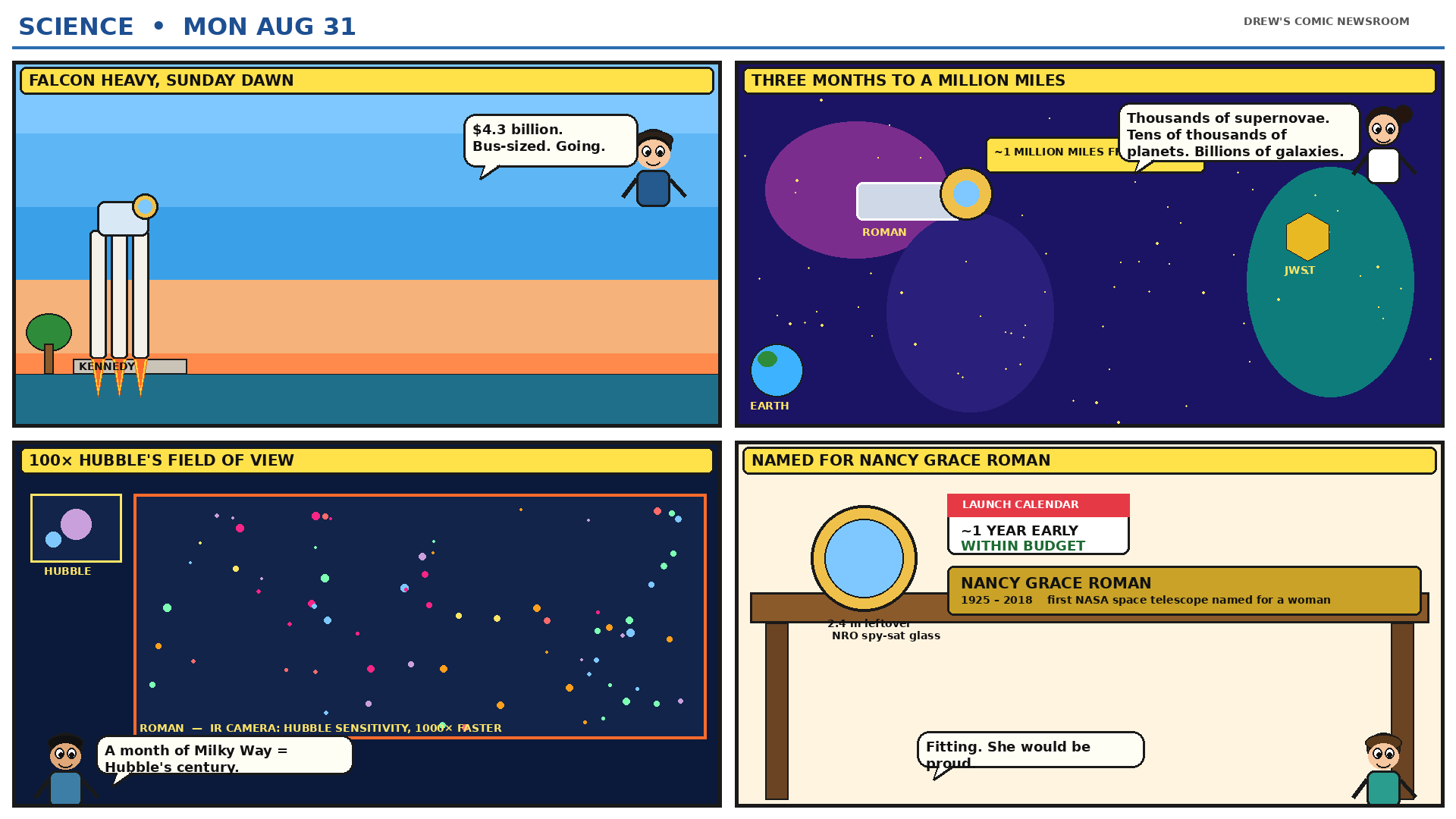
NASA’s newest crown jewel left the pad Sunday. AP aerospace writer Marcia Dunn, in a dispatch carried by ABC News on Aug. 30, 2026, reports that SpaceX launched the $4.3 billion Nancy Grace Roman Space Telescope shortly after daybreak on a Falcon Heavy from Kennedy Space Center. The rocket is the company’s triple-core heavy lifter. The payload is bus-sized. It is flying toward an observation point about 1 million miles (1.6 million kilometers) from Earth, the same neighborhood already occupied by the James Webb Space Telescope. The trip will take more than three months. Once it arrives, Roman is supposed to cast the widest gaze yet on the hidden parts of the universe from space, scanning faster than anything NASA has flown for this kind of survey work.
The numbers NASA is selling are the ones the strip is built on. Science mission director Nicky Fox told reporters the telescope will find thousands of supernovae, tens of thousands of planets, billions of galaxies, and tens of billions of stars. Its field of view is more than 100 times wider than Hubble’s, which is still taking celestial glamour shots after 36 years in orbit. Webb, by contrast, stares narrower and deeper, zooming in on objects almost as old as the Big Bang. Senior project scientist Julie McEnery said a month of Milky Way observations by Roman would take Hubble a century to finish, and that Roman should make quick work of scanning the galactic bulge at dead center. The wide-field infrared camera is built to match Hubble’s sensitivity while running about 1,000 times faster. Roman also carries an experimental coronagraph, an instrument meant to block starlight so faint planets around those stars can be photographed directly.
Why it matters
Speed is the point, not a prettier postcard. Hubble and Webb are still the close-up cameras. Roman is the survey engine that is supposed to find the weird, the rare, and the unusual so the other telescopes know where to point. McEnery’s line on the eve of launch was that the vast reach will redefine what it means to find a needle in a haystack. Dunn’s piece is explicit about the division of labor: once Roman spots new worlds, the more powerful and sensitive Webb can take aim to fill in the blanks. The same catalog of galaxies is also the dataset astronomers want for dark matter and dark energy, the unseen bulk of the universe whose effects show up as an expansion rate. Roman will not work alone. Dunn names the European Space Agency’s Euclid spacecraft and the National Science Foundation’s Vera C. Rubin Observatory in Chile as partners in the same hunt.
The hardware story is almost as odd as the science case. Roman’s primary mirror is nearly 8 feet, or 2.4 meters, across, the same size as Hubble’s, and it is leftover spy-satellite glass. The National Reconnaissance Office donated two unused mirrors to NASA more than a decade ago; the second is still in storage. The observatory is designed to be refueled if a robotic tanker shows up in the coming decade. It launched nearly a year ahead of schedule and within budget. It is also the first NASA space telescope named for a woman. Nancy Grace Roman was the agency’s first chief astronomer. She joined the brand-new NASA in 1959, argued that observatories above Earth’s atmosphere could see farther and better, hired people who later ran Hubble, and died in 2018 at age 93. Retired NASA scientist Ed Weiler, who called her the Mother of Hubble, told AP the honor was long overdue and that she would have been proud the namesake telescope is aimed at lingering questions such as dark energy.
Conclusion
A bus-sized infrared survey telescope is now on a three-month cruise to a million-mile parking spot next to Webb, carrying a Hubble-sized leftover spy mirror, a camera that is supposed to be a thousand times faster, and a coronagraph that wants to take baby pictures of other planets. Fox’s inventory is the one to keep: thousands of supernovae, tens of thousands of planets, billions of galaxies, tens of billions of stars, and a field of view more than a hundred times Hubble’s. McEnery’s comparison is the other: a month on the Milky Way versus a Hubble century. Dunn’s Aug. 30 AP story is the source, Sunday’s Falcon Heavy launch is the news, and the name on the side of the bus is Nancy Grace Roman. The comic is the launch, the cruise, the wide shot, and the nameplate. The science starts after the three-month commute.
Source: AP via ABC News