
Science and Space
Roman is go for Sunday morning
What happened
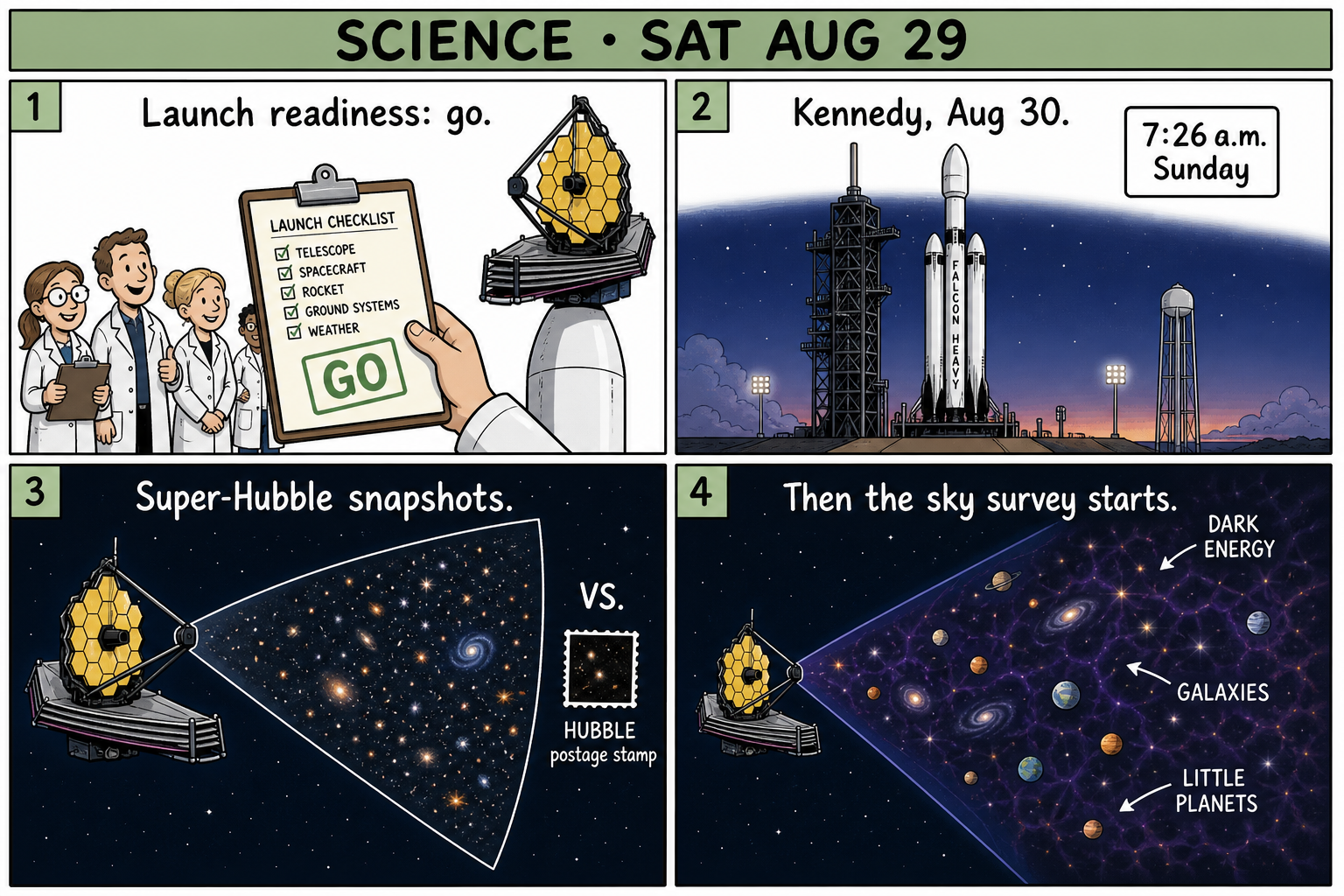
NASA’s Nancy Grace Roman Space Telescope is “go” for launch. The agency and SpaceX finished the Launch Readiness Review on Friday at Kennedy Space Center, the last gate before countdown, NASA’s Roman blog says. That review is the moment the rocket, the observatory, the weather shop, and the people on console all have to be ready at once. Liftoff is targeted for 7:26 a.m. EDT Sunday, Aug. 30, from Launch Complex 39A. Space Launch Delta 45 weather officers put favorable conditions at 60 percent. Teams were still working the Falcon Heavy in the hangar at 39A as of Wednesday, Aug. 26, which is the photo NASA put on the post.
It would be NASA’s sixth primary Falcon mission from Kennedy, after IXPE, Psyche, GOES-U, Europa Clipper, and IMAP. Roman is built for deep, sweeping surveys: dark energy and dark matter, planets around other stars, maps of billions of galaxies, black holes, and a public data flood. SpaceNews, covering the same pad, notes a 300-megapixel infrared camera, a coronagraph technology demonstration, a $4.3 billion budget, and a five-year prime mission headed for the Earth-sun L2 point, about 1.5 million kilometers out. The formal readiness date had been May 2027. Barring last-minute trouble, it leaves nearly nine months early.
Why it matters
Hubble and Webb take exquisite small patches of sky. Roman is the wide shot. Scientific American, writing ahead of the same launch, said the mirror can see about 100 times more sky in one exposure than Hubble or Webb, which is how you count galaxies and stars in bulk instead of one postcard at a time. That also means a data problem: NASA has said Roman may produce on the order of 1.4 terabytes of science data a day, hundreds of terabytes a year, in the neighborhood of Hubble’s entire lifetime of data. The point of “go” on Friday is that the hardware meant to feed that firehose is cleared to leave the ground.
If the clock holds, the observatory takes roughly 100 days to reach L2, commissioning on the way, with science starting after arrival. An early launch is not trivia. It is months of survey time that do not have to wait. Astronomers have already lined up extra programs that need a telescope which can stare at huge chunks of sky at once. The pad story is a countdown. The science story is a survey that has been waiting for a machine this wide.
Conclusion
Sunday morning is still only a weather percentage and a clock. No galaxy has been mapped yet, and no dark-energy plot has been drawn. What got the stamp is the machine that is supposed to do that work, and the last panel of the strip is the survey, not a trophy photo of a rocket. If it leaves the pad at 7:26 a.m., commissioning starts on the way to L2 and the story moves from hangar to sky. If it does not, the “go” was still the last honest status NASA could file on Friday.
Source: NASA