
Science and Space
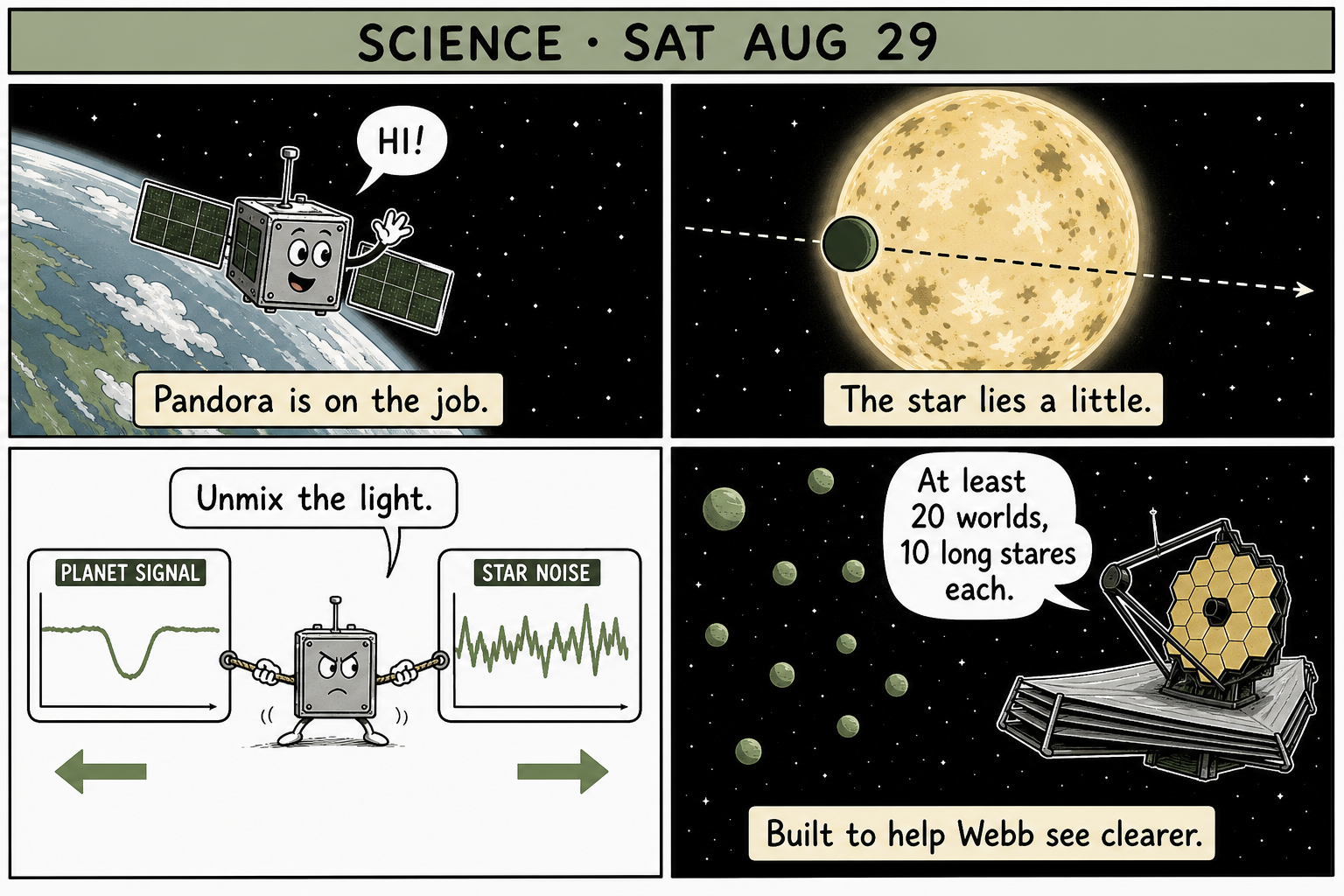
Pandora starts watching the star that lies a little
What happened
Pandora, NASA’s first Astrophysics Pioneers satellite, is now taking science data on exoplanets and the stars they orbit, NASA Science reports. The smallsat launched Jan. 11 into low Earth orbit. Deputy project manager Jordan Karburn at Lawrence Livermore says the spacecraft is healthy, the instruments are performing, and commissioning is done. The year-long primary mission will watch at least 20 exoplanets ten times each, with a 24-hour stare that includes a transit. The telescope is a novel all-aluminum design about 18 inches across, jointly developed by Livermore and Corning.
The problem it was built for is a cheat in the light. During a transit, starlight skims a planet’s air and picks up chemical fingerprints, including water. The instruments also see the whole star, which is splotchy: hot faculae, cool spots, all of it moving as the star rotates. Those features can fake or hide a water signal, MIT’s Benjamin Rackham says. Principal investigator Elisa Quintana at Goddard puts the gap simply: right now we cannot be entirely sure how the star’s light affects what we think is in the air. Pandora watches the star’s visible brightness and near-infrared spectrum at the same time, and grabs the planet’s near-infrared spectrum when it transits.
Why it matters
Webb is oversubscribed and cannot stare at one system for a day as a habit. Pandora can. Its near-infrared detector is a spare originally made for Webb. Project scientist Knicole Colón says combining the two data sets is how you start to map a star’s surface and cleanly separate star from planet. That is not a luxury measurement. Water in an exoplanet atmosphere is one of the first things you want, and it is one of the easiest signals for a spotted star to counterfeit. If you cannot unmix the star, you cannot trust the air.
Pioneers missions are cheap, fast, and allowed a higher tolerance for failure. Pandora’s bet is that a small telescope doing long dual-wavelength stares can do the unmixing that flagship time cannot spare. Data land at the NASA Exoplanet Archive. If it works, later searches for worlds that might be livable start with a cleaner subtraction, which is the only reason a comic about a tiny satellite belongs next to Webb in the last panel.
Conclusion
The satellite is on the job, the commissioning fight is over, and the science stares have started. The star still lies a little, because stars are splotchy and they rotate. Pandora’s whole mission is to catch that lie in both visible and infrared light, over and over, then hand Webb a less muddy spectrum. That is the science, and it is the caption, and it is why this package exists as a SmallSat story instead of a Webb rerun.
Source: NASA Science