
Science and Space
Extreme silicon-carbide transistor keeps switching at 1,110°F
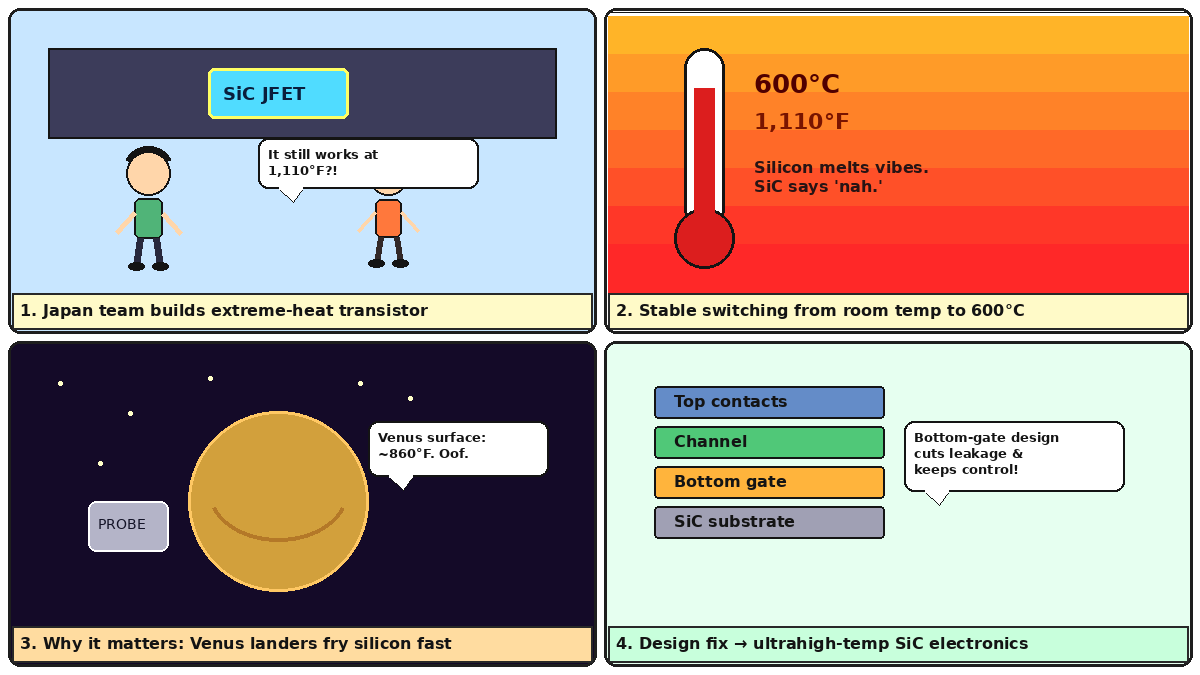
What happened Scientists in Japan have demonstrated a silicon carbide junction field-effect transistor (SiC JFET) that continues normal switching behavior at temperatures up to 1,110 degrees Fahrenheit (600 degrees Celsius), according to reporting on a study published August 17 in APL Electronic Devices and covered by Live Science on September 6, 2026. Transistors are the on-off valves of modern electronics; most consumer chips rely on silicon MOSFETs that cannot survive the brutal heat of places like the Venusian surface, where thick carbon dioxide air can hit about 860°F (460°C). Past landers have often lasted only a couple of hours before their silicon-based electronics failed—Venera 13’s roughly two-hour survival remains a famous benchmark for how quickly ordinary chips give up.
Earlier high-temperature SiC JFET attempts stumbled on two familiar gremlins: weak gate controllability and large leakage currents once the crystal lattice and substrate get hot. Dopant atoms can sit deeper than designed, shoving the voltage needed to open the channel around by more than a couple of volts. Above roughly 660°F, the substrate itself can become less resistive, leaking current around the intended path and turning a tidy switch into a soggy one.
The new design uses doped semiconductor “wells” around the device and a bottom-gate layout so the electric field that opens the channel is better defined. At about 750°F (400°C), the team reported threshold-voltage error under 0.1 volts, and the fabricated devices still behaved like transistors beyond 873 K—the kind of stability statement materials papers live for when the target environment is literally another planet.
Why it matters Deep-space surface missions, geothermal wells, and aerospace engine control all need low-power integrated circuits that do not melt their own logic. A transistor that stays predictable at Venus-class temperatures is not a finished lander computer, but it is a missing brick: without switches that hold their thresholds, you cannot build sensors, radios, or actuators that outlast a brief postcard from the surface. Silicon carbide has long been the favorite wide-bandgap candidate for this niche; the news is that a concrete device geometry finally attacks the controllability and leakage problems that kept prior SiC JFETs from looking mission-ready.
Conclusion Heat-proof electronics remain a materials-and-device story first. This bottom-gate SiC JFET shows stable ultrahigh-temperature operation in the lab, which is the prerequisite for longer Venus probes and other extreme environments—while reminding us that “survives 1,110°F” is a component milestone, not a spacecraft boarding pass yet. The next steps are the unglamorous ones: integrate more of these switches into full circuits, prove them under combined heat and radiation stress, and only then talk about multi-hour surface sorties.
Source: Live Science