
Finance
The 2026 HSA cap is $4,400, or $8,750 for family
What happened
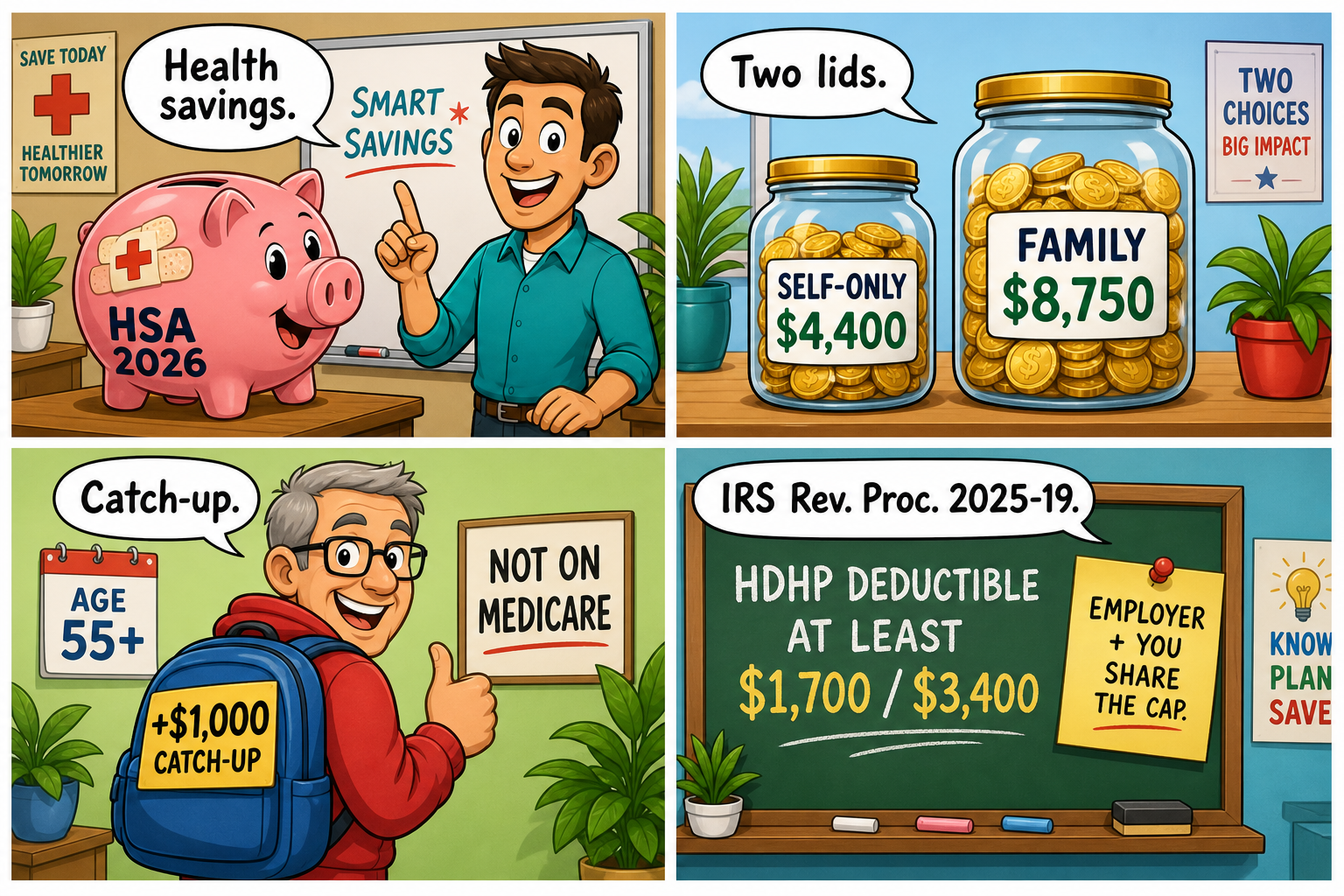
The Internal Revenue Service’s Rev. Proc. 2025-19 is the 2026 inflation table for Health Savings Accounts, not a shopping list. For calendar year 2026, the annual limitation on HSA deductions is $4,400 for a person with self-only coverage under a high-deductible health plan and $8,750 for family coverage. Those numbers are up from $4,300 and $8,550 in 2025, as tax summaries of the same procedure note. A contribution limit is a ceiling: the most the code will recognize for the year, counting employee and employer dollars together. It is not a grade, not a target, and not advice to fill the jar to the rim. Some households will put in less. Some will not be in an HSA-eligible plan at all.
The same revenue procedure defines the 2026 high-deductible health plan that makes someone HSA-eligible. The annual deductible must be at least $1,700 for self-only coverage or $3,400 for family coverage. Annual out-of-pocket expenses — deductibles, co-payments, and other amounts, but not premiums — may not exceed $8,500 self-only or $17,000 family. Fidelity’s explainer of those IRS figures also repeats the longstanding $1,000 catch-up for people age 55 or older who are not enrolled in Medicare. That catch-up is on top of the $4,400 or $8,750, and it is still a cap, not a chore.
An HSA is a medical savings account tied to that HDHP. Money can go in pre-tax, can roll over year to year, and can come out tax-free for qualified medical expenses. After 65, non-medical withdrawals are generally taxed like a traditional IRA withdrawal. None of that is a fund recommendation. It is the account type the IRS is measuring. If an employer puts $1,000 in, that $1,000 uses part of the $4,400 (or $8,750) lid. The employee room shrinks by the same amount. The sticky note on the strip is that sentence: employer plus you share the cap.
Why it matters
Yesterday’s filing was the 401(k) employee deferral. Today’s is a different jar. An HSA is not an emergency fund. It is not a 401(k). It is a health-account ceiling with a triple tax design the code already wrote. Educational explainers often put a small cash cushion first and an HSA later, or the other way around. This desk is not ranking those sequences. It is labeling the 2026 numbers so a reader can find them in Rev. Proc. 2025-19 instead of on a slideshow. No tickers. No “max this.”
The HDHP floors are the eligibility gate. Without a plan that meets the deductible and out-of-pocket tests, the $4,400 figure does not apply. Age 55 unlocks the extra $1,000 only if the person is not on Medicare. Those are the official markings. Notice the jars, not a to-do list.
Conclusion
For 2026 the IRS set HSA contributions at $4,400 self-only and $8,750 family, with HDHP deductibles of at least $1,700 and $3,400, out-of-pocket caps of $8,500 and $17,000, and a familiar $1,000 catch-up at 55. Those are lids. The strip is a bandaged piggy, two jars, a catch-up backpack, and a chalkboard citing Rev. Proc. 2025-19. Education about published ceilings, not advice. Source: https://www.irs.gov/pub/irs-drop/rp-25-19.pdf
Source: Internal Revenue Service