
Finance
How the Fed’s money measures work — and why stablecoins complicate M1 and M2
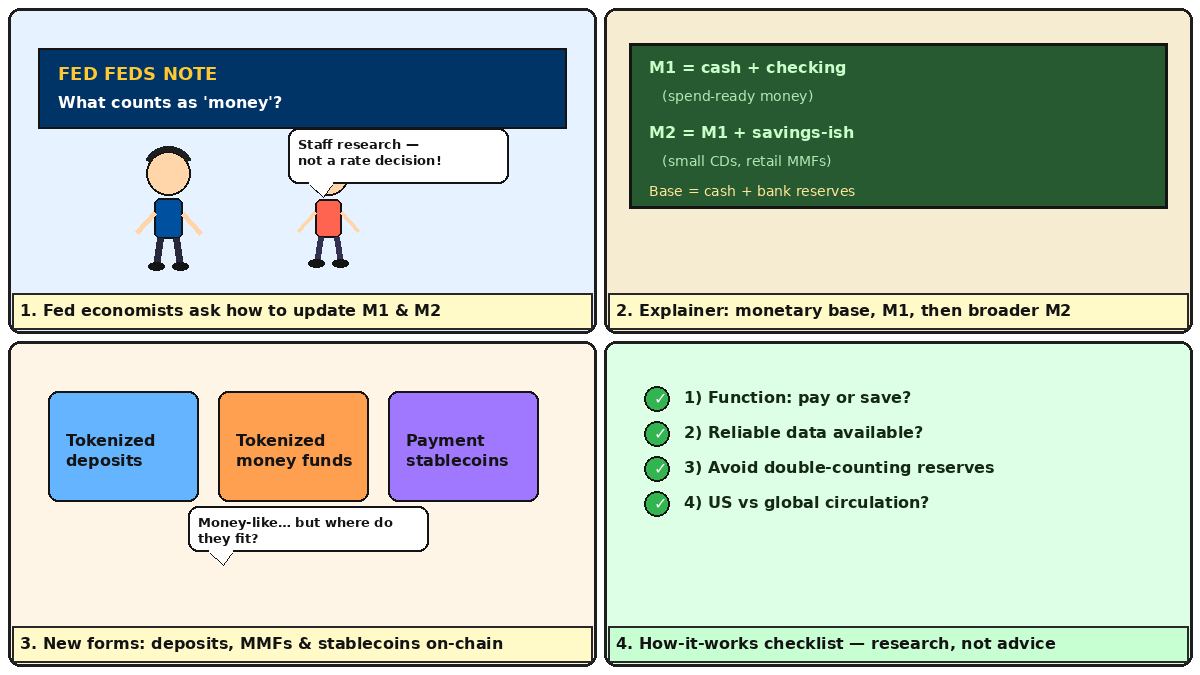
What happened Federal Reserve staff published a FEDS Note dated September 4, 2026, titled “New Forms of Money and the U.S. Monetary Aggregates.” It is independent research reflecting only the authors’ views, not a policy decision on interest rates and not a vote to redefine the official money supply tomorrow morning. The note walks readers through how the United States currently builds three nested measures: the monetary base (currency in circulation plus bank reserve balances at the Fed), M1 (the narrow, spend-ready stock of currency plus demand deposits and similar transferable balances), and M2 (M1 plus less liquid savings-style instruments such as small time deposits and retail money market funds).
Then it asks a practical statistics question for a digital era: as tokenized deposits, tokenized money funds, and payment stablecoins take on money-like features, how could compilers decide whether—and where—those instruments belong inside the published aggregates? The educational core is a two-part analytical approach. First comes functional classification: assets that behave mainly as a medium of exchange (highly liquid, ready for payments, low yielding) usually map toward M1, while assets that behave mainly as a short-term store of value (liquid but needing redemption, used more like savings) usually map toward the non-M1 part of M2.
Second come four measurement chores that sound boring until you skip them. You need reliable timely data on how much of the instrument exists, a uniform reporting pipe so different issuers are counted the same way, a plan to avoid double-counting when token reserves already sit inside bank deposits or money-fund assets that M1 or M2 already include, and clarity on whether the measure is tracking U.S. circulation or a global float of tokens that never touch domestic payments.
Why it matters Households and businesses hear “money supply” tossed around as if it were one dial on the wall. In reality, M1 and M2 are construction projects whose definitions have changed before whenever finance invented new wrappers for cash-like claims. Payment stablecoins and tokenized products can look like brand-new money while their backing sits in instruments the aggregates already count, so a naive headcount of tokens could inflate the published stock without adding new spending power. Reading the Fed’s measurement logic—without treating a staff note as investment advice, a ticker tip, or a trading signal—helps decode future headlines about “stablecoins in M1” as accounting and statistics problems first.
Conclusion The takeaway is caps-and-definitions, not buy-or-sell: money aggregates are labeled buckets, new digital instruments only enter those buckets after function and measurement tests, and double-counting plus geography are the traps that keep this story in the explainer lane. Treat the September 4 note as a how-things-work briefing on M1 and M2 in 2026, and you will be ready when the next “what counts as money” headline arrives.