
Finance
401(k) employee cap is $24,500 in 2026
What happened
The Internal Revenue Service’s 2026 retirement-plan cost-of-living notice is a table of caps, not a shopping list. IR-2025-111, with details in Notice 2025-67, raises the annual employee elective-deferral limit for 401(k), 403(b), governmental 457 plans, and the federal Thrift Savings Plan to $24,500, up from $23,500 in 2025. That number is the most a worker can elect to have taken from pay into those plans for the year, traditional or Roth, across accounts that share the cap. It is not a recommendation to put in $24,500. It is the ceiling the code will recognize. The same release lifts the IRA contribution limit to $7,500 from $7,000.
Catch-up math sits next to those two headlines. For employees aged 50 and over in most 401(k), 403(b), governmental 457, and TSP plans, the catch-up limit is $8,000, up from $7,500, so the IRS’s own addition is $32,500 in combined employee deferral plus standard catch-up. SECURE 2.0 still gives ages 60, 61, 62, and 63 a higher catch-up; for 2026 that higher amount remains $11,250 instead of $8,000. IRA catch-up for age 50 and over is $1,100, up from $1,000. SIMPLE-plan elective deferrals move to $17,000 from $16,500, with their own catch-up schedule. None of those lines is a stock tip. None names a fund.
The IRS also moved several income ranges that decide whether an IRA contribution is deductible, whether a Roth IRA contribution is allowed, and whether a worker can claim the Saver’s Credit. Single taxpayers covered by a workplace plan see a deductible-IRA phase-out between $81,000 and $91,000. Joint filers with the contributing spouse covered at work sit between $129,000 and $149,000. Roth IRA phase-outs for singles and heads of household run $153,000 to $168,000. Those brackets are eligibility gates. They do not tell anyone which account to open.
Why it matters
A contribution limit is a fence. It tells payroll and the plan how much employee money can go in before the year is full. Employer matching dollars are a separate pile under a combined annual-additions cap; the $24,500 figure in the headline is the employee deferral, not the company match. People who only ever hear “max your 401(k)” can miss that the first useful question is whether the plan even has a match, and whether the paycheck can spare the deferral without raiding rent. This desk is not ranking those choices. It is labeling the 2026 numbers so a reader can find them on IRS.gov instead of on a slideshow.
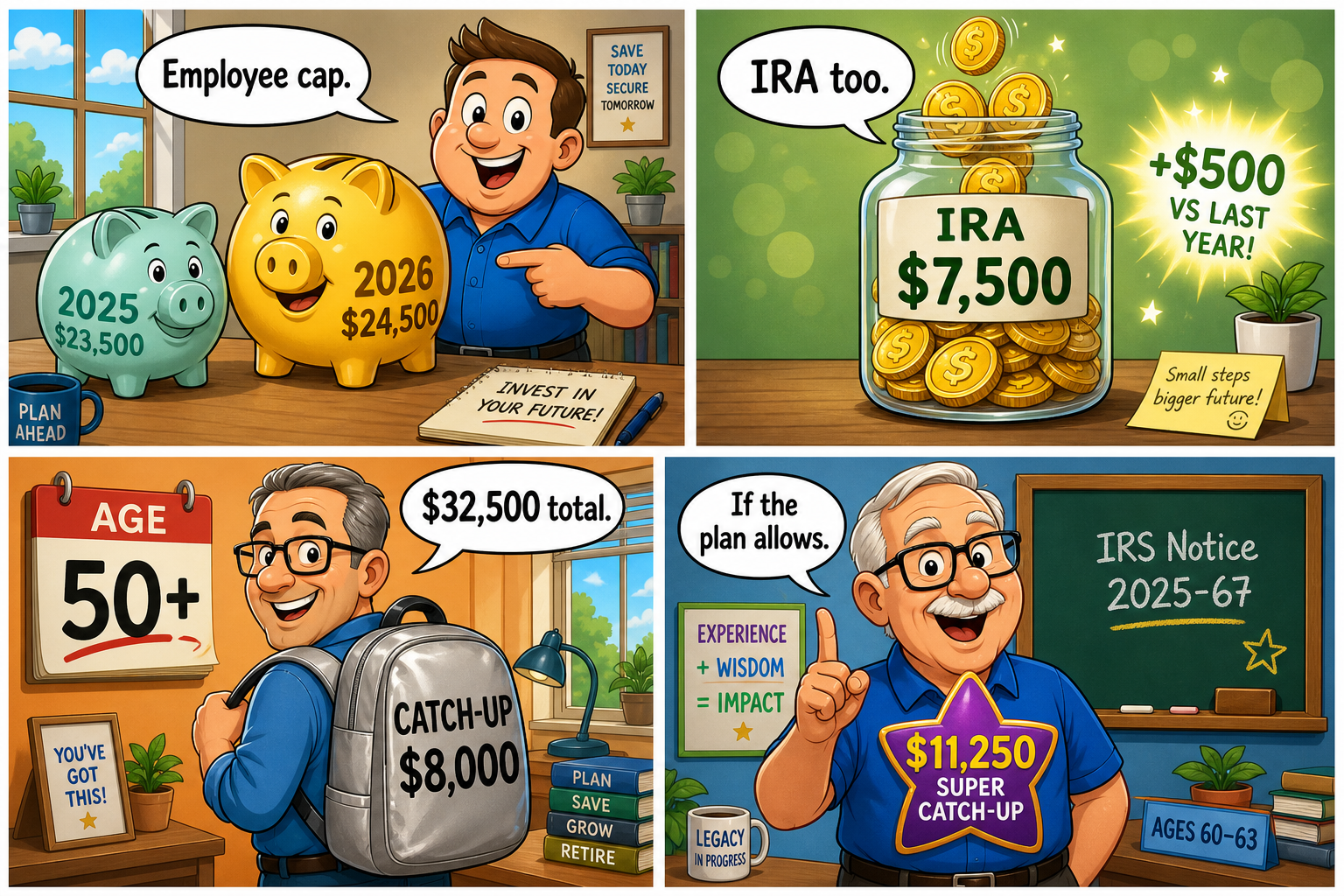
The age bands are the other practical piece. Turning 50 in 2026 is what unlocks the $8,000 catch-up in most plans, for a $32,500 employee total if the plan allows catch-ups. Ages 60 through 63 keep the $11,250 super catch-up if the plan document permits it. That is a plan-document question, which is why the last panel of the strip says “if the plan allows.” Notice 2025-67 is the citation for payroll teams who have to code the new ceilings. Readers who want the official arithmetic should use the IRS page, not a cartoon piggy bank.
Conclusion
For 2026 the IRS set the shared 401(k)-style employee deferral at $24,500, the IRA at $7,500, the common age-50 catch-up at $8,000, and left the ages-60-to-63 super catch-up at $11,250. Those are caps. They are not advice to fund them, not a ranking of funds, and not a forecast. The strip is last year’s $23,500 piggy next to this year’s $24,500, an IRA jar, a catch-up backpack, and a super-catch-up star on a chalkboard that reads Notice 2025-67. Source: https://www.irs.gov/newsroom/401k-limit-increases-to-24500-for-2026-ira-limit-increases-to-7500
Source: Internal Revenue Service