
Finance
Knowing money words is not the same as handling money
What happened
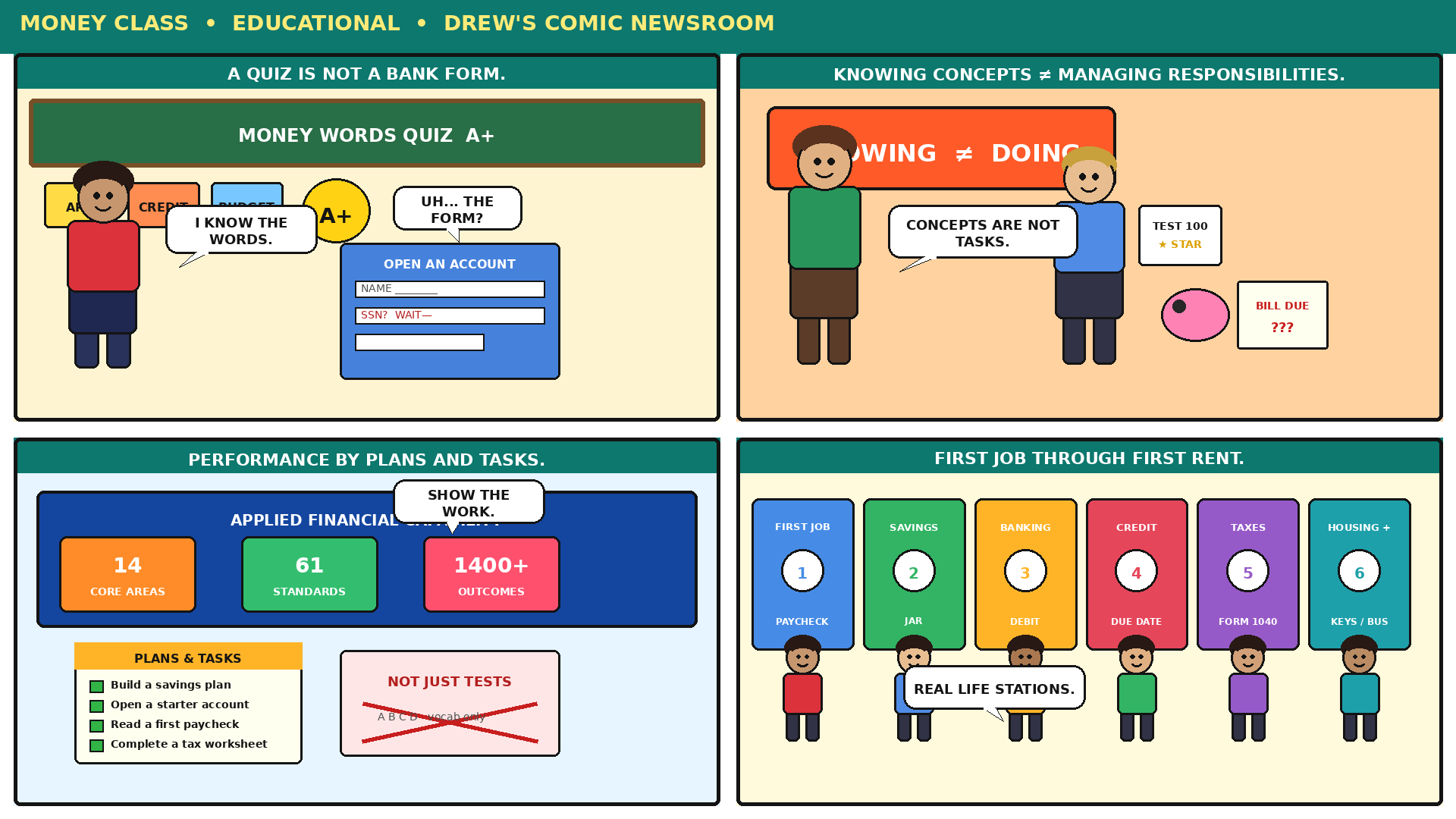
The National Financial Educators Council released the Applied Financial Capability Standards for public review and comment on August 26, 2026, in a Dallas-dated EIN Presswire notice. The standards are meant for high school students and transition-age youth who are not yet living independently. They set measurable expectations for the near-term money decisions those students will face as they move toward adulthood. The point of the release is not a new vocabulary list. It is a claim that current classroom standards stop at concepts, and that the next step is demonstrated capability: applying what you learn, completing real tasks, building usable systems, and producing resources a student can actually keep. CEO Vince Shorb put the gap in one sentence: knowing financial concepts is not the same as being able to manage real financial responsibilities. “Our students deserve more than financial concepts,” he said. “Financial education should ensure students can make real decisions, complete meaningful tasks, build systems, and manage money in real life.”
The framework is large on purpose. It is organized across 14 core areas, 61 standards, and more than 1,400 Enabling Learning Outcomes. Each standard cluster covers a major slice of near-term decision-making and states the overall outcome, the need it addresses, and relevant safety and privacy considerations. Individual standards then name the decisions, tasks, and competencies a student should be able to show, with performance expectations and evidence of achievement. Those break into Learning Objectives and more detailed Enabling Learning Outcomes that are supposed to guide instruction, application, and assessment. Achievement is measured by what students produce and demonstrate — plans, completed tasks, systems, usable resources — not by a knowledge test alone. NFEC says that is the difference from the financial education standards already used in high schools.
Why it matters
NFEC’s own review of mandates and academic standards across all 50 states, published as the National Evaluation of State Financial Literacy Mandates and Academic Standards Alignment, found that no state offering high school financial education used outcome-based performance measures across its standards, and that few required meaningful real-world application. Traditional standards, in the council’s telling, emphasize definitions and lower-order thinking. Foundational knowledge still matters. Knowledge alone, the release argues, does not prove a student can open a first account, start a savings plan, read a first paycheck, handle a first-income tax form, or navigate early housing and transport costs. The Applied Financial Capability Standards were written to close that gap by scoring what a student can do, not only what a student can name.
The four design choices in the press note are the whole pedagogy. The standards are built around demonstrated capability. They emphasize applied learning and applied readiness, so students practice making the decision before the day it actually arrives. They include performance-based assessment, so a passing mark can be a completed plan or a finished task rather than a multiple-choice sheet. And they keep a near-term, real-world focus: the first two years of moving toward self-sufficiency, not a survey of every market product. The everyday stations in the strip are the ones the brief names: first jobs, savings, banking, credit, first-income taxes, and early housing and transport. There is no ticker, no hot list, and no product pitch. Schools, educators, youth-serving groups, researchers, and other stakeholders are invited to comment. Contributors whose ideas are incorporated are to be named, with affiliation, in the published standards. NFEC identifies itself as an IACET Accredited Provider and a Certified B Corporation that builds standards, trains educators, and publishes curriculum resources. Review and comment run through the council’s public-comment application, linked from the August 26 release.
Conclusion
A perfect score on money words is not a bank form, a savings plan, a first-job budget, or a completed tax worksheet. Shorb’s line is the caption: knowing concepts is not managing responsibilities. Fourteen core areas, 61 standards, and more than 1,400 outcomes are the size of the bet that classroom financial education can be scored on performance. This package is education about that standards release. It is not investment advice, not a product recommendation, and not a markets piece.
Source: EIN Presswire