
Conspiracy Theories
Tallinn Lootsi cog’s oak traced to Lithuanian coast, 1370s
What happened
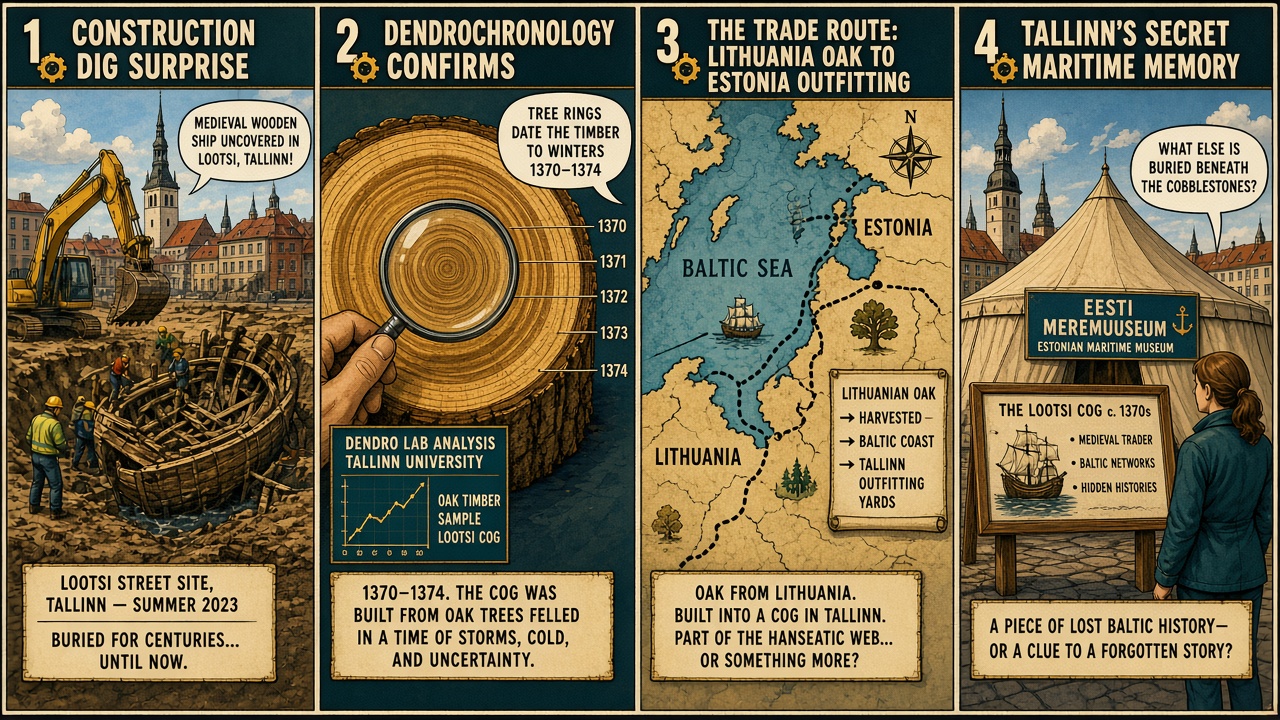
ERR reports that the Lootsi 8 medieval cog uncovered during construction in Tallinn has been traced, via dendrochronology, to oak harvested on the Lithuanian coast. The hull was found in spring 2022 at the Lootsi Street site — if comic art stamps summer 2023, verified prose overrides the panel. Entertainment and pop-history archaeology only — quietly skip any modern political framing. That is the Conspiracy Theories slot as weird-but-sourced deep-time oddity with a source URL, not a claim about living people.
A Dendrochronologia study places lower-hull oak in winters 1370–72 along the Lithuanian coast, with upper works and galley timber from 1373–74; local Tallinn wood handled final touches. Moon rings reinforced the structure. The ship appears to have been relatively new when it sank, and ship rats were aboard. Research credits run to the University of Tartu, the Estonian Maritime Museum, and collaborators in Copenhagen. Hard house rule: never politics, never antisemitism, never a conspiracy-of-people framing. Weird-but-sourced medieval archaeology only. Bright parchment gold and Baltic teal. White gutters.
The cartoon is illustrative if panels invent “forgotten secret” slogans or Hanseatic mystery banners the report does not photograph; verified prose sticks to Lootsi 8, spring 2022 construction find, Lithuanian-coast oak 1370–72 lower hull, 1373–74 upper/galley, local Tallinn finishing wood, moon-ring reinforcement, relatively new when sunk, ship rats, University of Tartu, Estonian Maritime Museum, and Copenhagen. Ignore invented “secret maritime memory” conspiracy hooks that may appear inside comic art.
Why it matters
Readers get Tallinn’s Lootsi 8 cog, the spring 2022 dig, the Dendrochronologia Lithuanian oak timeline, the local finishing wood, moon rings, the relatively new sinking, ship rats, and the Tartu / Maritime Museum / Copenhagen credits. Keep modern politics out. Keep the ERR URL on the page. A medieval trader rebuilt from Baltic oak rings is the strip — entertainment archaeology, not a modern conspiracy claim.
Conclusion
The Lootsi 8 medieval cog found in spring 2022 construction in Tallinn has been traced by a Dendrochronologia study to Lithuanian-coast oak from winters 1370–72 for the lower hull and 1373–74 for upper works and galley timber, with local Tallinn wood for final touches, moon-ring reinforcement, a relatively new vessel when it sank, and ship rats aboard — per ERR citing University of Tartu, Estonian Maritime Museum, and Copenhagen collaborators. Pop-history only. Source: https://news.err.ee/1610077024/medieval-ship-found-in-tallinn-traced-to-lithuanian-builders
Source: ERR