
Conspiracy Theories
Bianfu Cave yields first Denisovan forearm bone in Yunnan
What happened
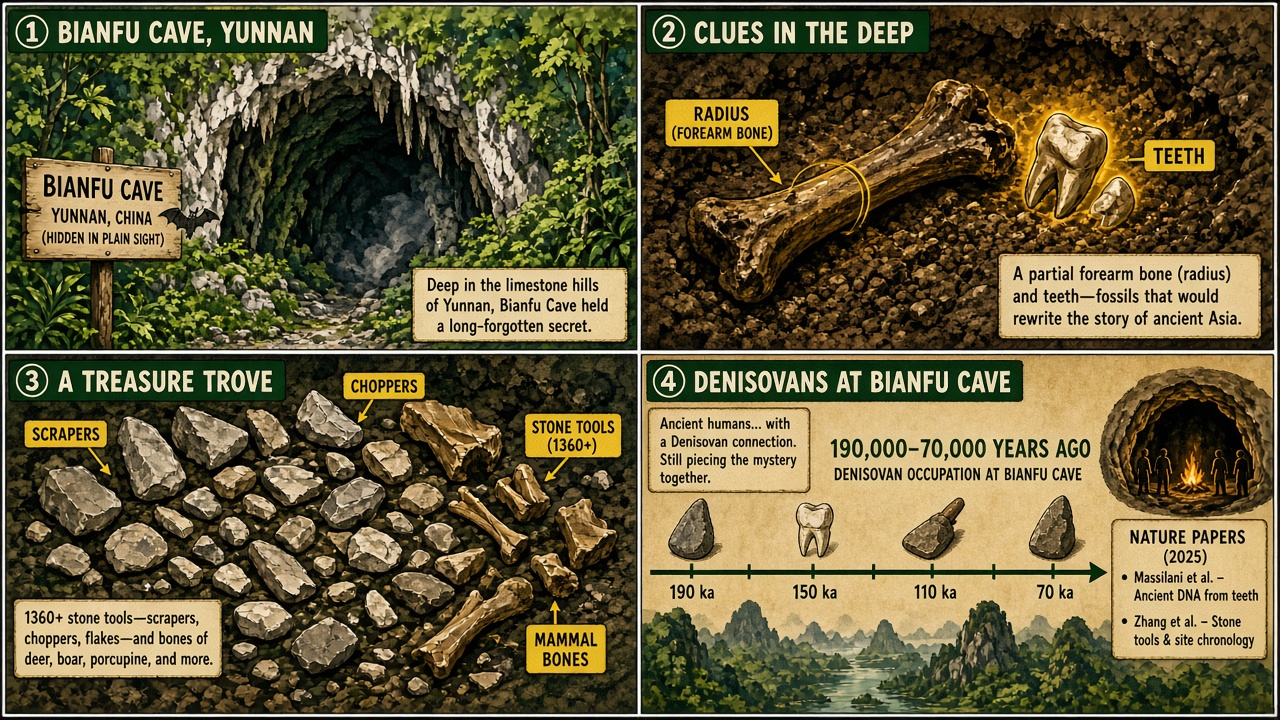
National Geographic reports that Bianfu Cave in Yunnan has produced the first Denisovan forearm bone — a radius — along with skull fragments and teeth, identified through protein collagen analysis rather than DNA. The human bones date to roughly 167,000–134,000 years ago, while evidence of site use spans about 190,000–70,000 years ago. Excavators also recovered more than 1,360 stone tools and roughly 60,000 mammal bone fragments. Two Nature papers dated September 9, 2026, carry the scientific results. Ignore wrong paper years or DNA claims that may appear inside comic art; the verified ID method is collagen protein, not DNA.
Hard house rule: never politics, never antisemitism, never a conspiracy-of-people framing. Weird-but-sourced deep-time pop-history only. Conspiracy here means entertainment and unexplained-adjacent oddities with a receipt — a lost human lineage’s forearm turning up in a Yunnan cave is the right shape: weird, dated, and still fun after the lab lesson. Bright limestone green and fossil ochre. White gutters.
A first forearm bone with a collagen ID and a dual Nature drop is a clean pop-history slot. Readers get Bianfu Cave, the radius, skull fragments and teeth, the protein method, the ~167k–134k ya bone window, the ~190k–70k ya site span, the 1360+ tools, the ~60k mammal fragments, and the Sept. 9 Nature pair — not a sermon and not a hidden-empire claim.
Why it matters
Readers get the Yunnan cave, the first Denisovan radius, accompanying skull fragments and teeth, collagen protein ID without DNA, bone ages ~167k–134k ya, site use ~190k–70k ya, 1360+ stone tools, ~60,000 mammal bone fragments, and two Nature papers from Sept. 9, 2026. Keep politics out. Keep the National Geographic URL on the page. A folklore-adjacent mystery with a lab punchline is the strip.
Conclusion
Bianfu Cave in Yunnan yields the first Denisovan forearm (radius) plus skull fragments and teeth via collagen protein ID — bones ~167k–134k ya, site use ~190k–70k ya, 1360+ tools, ~60k mammal fragments — in two Nature papers dated Sept. 9, 2026, per National Geographic. Pop-history only. Source: https://www.nationalgeographic.com/history/article/denisovans-forearm-bone-china
Source: National Geographic