
Conspiracy Theories
Beartooth dig: Clovis hearth find in a place that ‘should not exist’
What happened
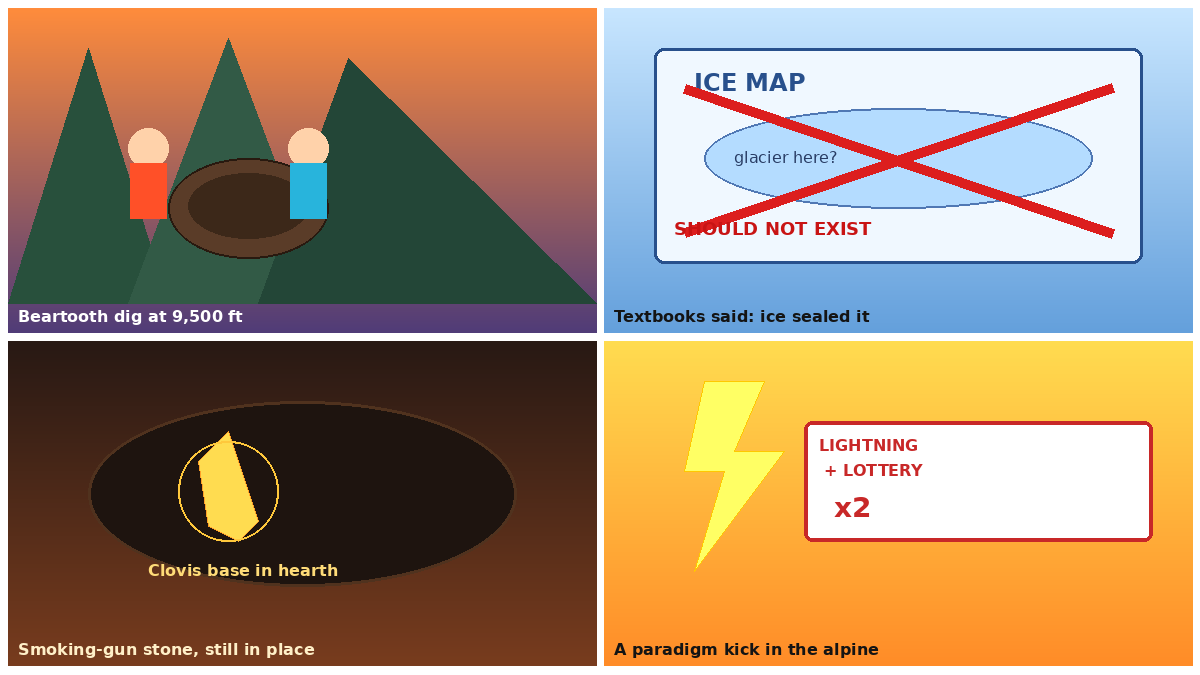
Mountain Journal, dated 6–7 September 2026, reports that archaeologist Scott Dersam and his Alpine Ecosystems Research Institute crew, working high in the Beartooth Mountains a few miles outside Yellowstone’s border, uncovered what Dersam calls a smoking-gun Clovis find: a Clovis point base sitting in the middle of an ancient hearth, still in undisturbed subsurface context. Prevailing paleoecology and glaciology say that basin should have been under massive Pinedale ice about 13,000 years ago — the era of Clovis people — which is why Dersam keeps repeating that the sediment, the ecosystem, and the habitation “should not exist.” Soil tests he cites show sun-exposed dirt dated to windows when ice maps said the place was sealed. Over four years he has logged six high-elevation Clovis sites, five in the Beartooths; until now, Montana’s only noncontroversial Clovis site was Anzick at lower ground.
The summer 2026 hearth moment was captured on a phone video: brush, then a dental-tool pick, then “Yep, that’s a Clovis base. In the middle of the goddamn hearth.” Students gasped. They had been digging for dirt data, not artifacts. Dersam’s line afterward was lottery-and-lightning twice in one day — a career find that would turn sixty years of high-elevation Paleoamerican assumptions on their head if lab dating holds. He leaves most artifacts in place, removes only pieces walkers might pocket, and frames the work as reconstructing mountain use rather than filling display cases. Peer review and publication are still ahead. This desk is filing the alpine mystery as pop-history archaeology and unexplained science-adjacent curiosity: odd dirt, odd ice maps, odd stone in a hearth. No politics. No identity fights. No modern conspiracy boards.
Why it matters
Conspiracy, on this beat, means the entertainment of a paradigm kick — a place ice charts said was empty suddenly showing full Clovis sites and a hearth toss that never moved. Readers get the Beartooths, the “should not exist” quote, the subsurface point, and the lightning-lottery stamp. House form is peaks, crossed-out ice map, glowing hearth stone, and the comic seal. Bright alpine sunset colors. White gutters. Absence of evidence is not evidence of absence, as one student said on survey day; here the evidence showed up where the textbooks said it could not.
Keep the tone at unexplained archaeology, not doom prophecy. The comic is a dig pit and a paradigm bruise, not a campaign flyer and not a cryptid costume. Dersam’s off-site method — dirt more than display cases, most flakes left where they lie — is part of why the find reads as a mystery of context rather than a trophy hunt. If the lab dates land, the ice map redraws. If they do not, the story was still the summer gasp in the pit.
Pop-history alpine archaeology belongs on this desk when the science-adjacent curiosity is the hook: sediment that saw sun when glaciers should have buried it, Clovis tools high where mammoth specialists were not supposed to linger, a hearth that held a broken point for thirteen millennia. That is UFO-adjacent wonder without inventing aliens. No politics. No modern grievance boards.
Conclusion
High Beartooth Clovis sites and a hearth-buried point base are the Mountain Journal mystery of the week — a place that “should not exist,” pending the labs. Pop-history archaeology only. Source: https://mountainjournal.org/ancient-archaeological-mystery-revealed-high-in-beartooth-mountains/
Source: Mountain Journal