
Technology and AI
Stanford’s virtual biotech fields 37,000 AI agents on drug discovery
What happened
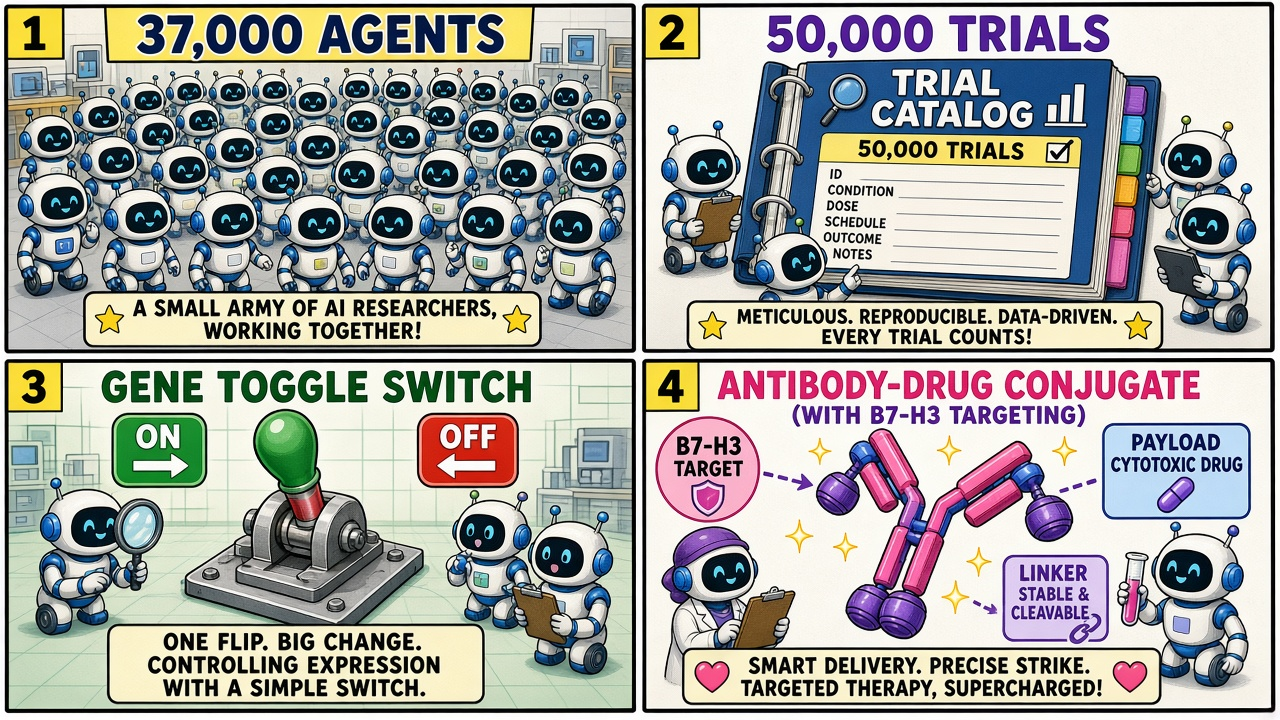
Stanford Medicine’s Hanae Armitage, writing Sept. 17, 2026, reports that associate professor James Zou and graduate student Harrison Zhang built a virtual biotech company staffed by about 37,000 AI agents — no lab benches, no lunch breaks, no payroll — and published the work in Science the same day. The agents mirror a brick-and-mortar org chart, with a chief science officer agent coordinating specialized teams across target finding, molecular design, and trial planning. That is the AI filing: an all-agent drug shop that actually shipped testable ideas.
One agent per trial, the team catalogued roughly 50,000 clinical trials in under a week — work Zou said would take human analysts years. For trials with single-cell data, agents scored how cell-type-specific a drug was and whether the target gene behaved like an on/off switch (high bimodality) versus a dimmer. High scores in both bins correlated with better outcomes: drugs aimed at switch-like genes were about 40% more likely to advance from Phase 1 to Phase 2, 48% more likely to reach market, and logged about 32% fewer adverse events in the analysis. Separately, the agents designed an antibody-drug conjugate against B7-H3 using only pre-January 2025 information; in August 2025 a major pharma independently landed on the same strategy and later earned FDA breakthrough therapy designation. Bright lab colors, white gutters, cartoon robot scientists only — never living likenesses. The Stanford Medicine URL is the receipt.
The virtual shop is not replacing wet labs. Zou’s next step is to move new candidate findings into real experiments. Readers get the 37,000-agent headcount, the 50,000-trial sweep, the switch-like gene lift numbers, the B7-H3 independent match, the Science publication date, and the Knight-Hennessy / NIH / NSF / Biohub funding note — one Friday AI slot from Palo Alto.
Why it matters
Drug discovery burns years and fortunes on candidates that fail in humans. A signal that single-cell “switchiness” and cell-type focus predict cleaner paths is the kind of pattern humans can miss at 50,000-trial scale. The B7-H3 story is the punchline: an AI design that later showed up in the real pipeline. Color on the robot grid and the green switch. White gutters. Readers get Zou’s quote on better drugs from single-cell features, the Phase and safety lifts, and the source URL on the page.
Conclusion
Stanford’s virtual biotech — roughly 37,000 AI agents led by Zou and Zhang — mined ~50,000 trials for switch-like target signals and independently sketched a B7-H3 antibody-drug conjugate that a pharma later matched, as reported Sept. 17, 2026, by Stanford Medicine and published in Science. Cartoon bots only. Source: https://med.stanford.edu/news/all-news/2026/09/virtual-biotech-company.html
Source: Stanford Medicine