
Technology and AI
CaLR: Causal Latent Revision aims to fix diffusion reasoning’s soft logic
What happened
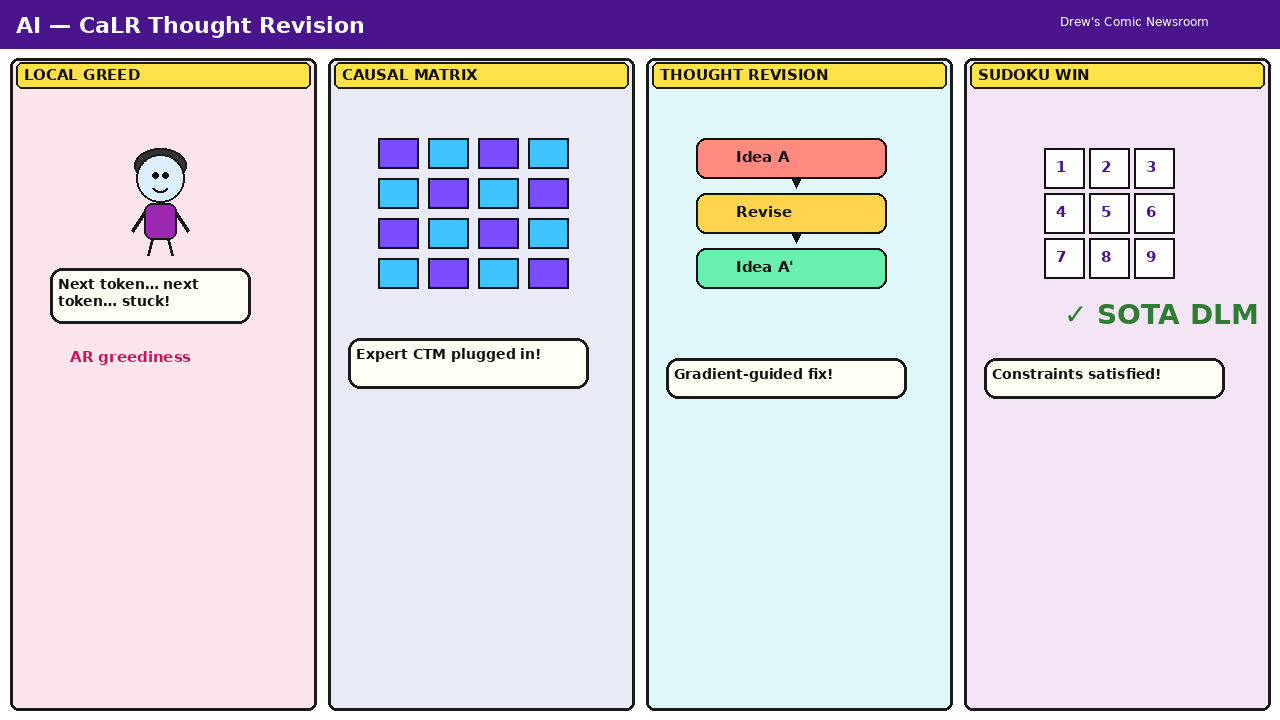
The AI filing is arXiv:2609.20981, submitted Sept. 17, 2026: CaLR — Causal Latent Revision for Robust Diffusion Reasoning — from Wei Cai, Jian Zhao, Yuchen Yuan, and Xuelong Li. The abstract says autoregressive models suffer from local greediness while diffusion language models often lack the strict causal structure required for reasoning. CaLR reframes reasoning as constrained latent optimization: it adopts a causal topology matrix from an expert model and uses implicit differentiation so the system can run gradient-guided “thought revision,” dynamically self-correcting intermediate steps during parallel generation.
Empirically, the authors report state-of-the-art diffusion language model performance on complex benchmarks, surpassing strong autoregressive baselines and showing stronger robustness on constrained tasks such as Sudoku. Bright purple matrix tiles, cyan diffusion clouds, and green checkmarks. White gutters. The arXiv abstract URL is the receipt. This is a methods strip, not a product launch.
Readers get the dual-problem setup (AR greediness vs. DLM weak causality), the CTM-plus-implicit-diff trick, the thought-revision framing, the SOTA claim, the Sudoku robustness note, and the source URL—not a full paper walkthrough, just Monday’s wire from the abstract.
Why it matters
A diffusion reasoner that can revise intermediate thoughts under a causal topology is the strip for anyone watching how language models move past next-token greed. Color on the matrix and the revision arrows. White gutters. Readers get why AR and DLM each leave a gap, how CaLR borrows an expert causal topology, why gradient-guided revision matters during parallel generation, the reported benchmark and Sudoku results, and the source URL on the page.
Conclusion
CaLR (arXiv:2609.20981) proposes Causal Latent Revision to give diffusion language models stricter causal structure via an expert causal topology matrix and implicit differentiation, enabling gradient-guided thought revision during parallel generation and reporting SOTA DLM results with stronger constrained-task robustness such as Sudoku, per the Sept. 17, 2026 abstract. Source: https://arxiv.org/abs/2609.20981
Source: arXiv