
Technology and AI
Internal probes beat the answer: a 0.6B model says YES to everything
What happened
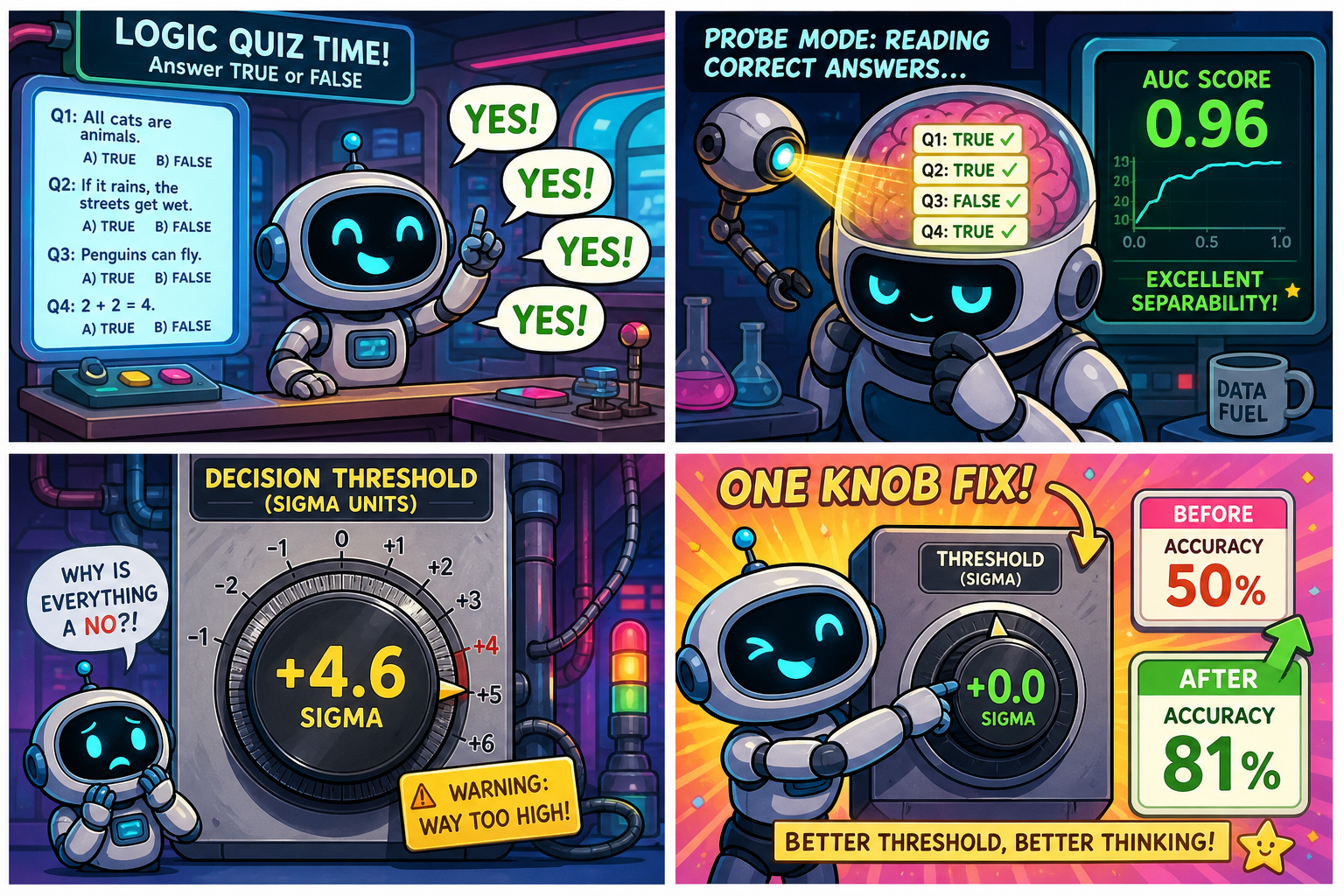
arXiv paper 2609.04582, submitted 4 September 2026 by Gnaneswar Villuri, Hashmath Shaik, and Alex Doboli, studies a familiar failure mode: a 0.6B language model asked to verify 1,200 logical conclusions answers YES every time. Judged by behavior it discriminates nothing. Linear probes on its hidden states still read the correct verdict at 0.96 AUC, transferring to unseen logical structures.
The authors locate the loss at a single scalar. The verdict survives into the model’s own output logits along a well-aligned readout direction — margin AUC about 0.89 — but a saturated decision threshold offset by roughly +4.6 sigma erases it. Across many configurations, behavioral accuracy collapses as a function of that threshold offset. A one-parameter correction, never fit on the evaluated structures, repairs behavior from 50% to 81% at 0.6B; calibrated margin decoding recovers about 94% at 8B. Comparing probe to margin separates three regimes: concealed, miscalibrated, and undetected.
Why it matters
AI packages here prefer a measurable method over hype. Recalibrating a threshold is not a jailbreak recipe and not a product endorsement. The comic is the yes-bot, the probe flashlight, the stuck sigma dial, and the one-knob fix. Bright lab colors. No brand logos.
Readers get the numbers and the regimes. Skip anything that wanders into how to bypass safety systems. This is an audit story about knowledge that already exists inside the network.
Conclusion
Probes can beat free-form answers when a miscalibrated threshold conceals knowledge the model already ranks correctly, per arXiv 2609.04582. Source: https://arxiv.org/abs/2609.04582
Source: arXiv