
Technology and AI
Persistent recurrent memory between transformer layers cuts eval loss 28.5%
What happened
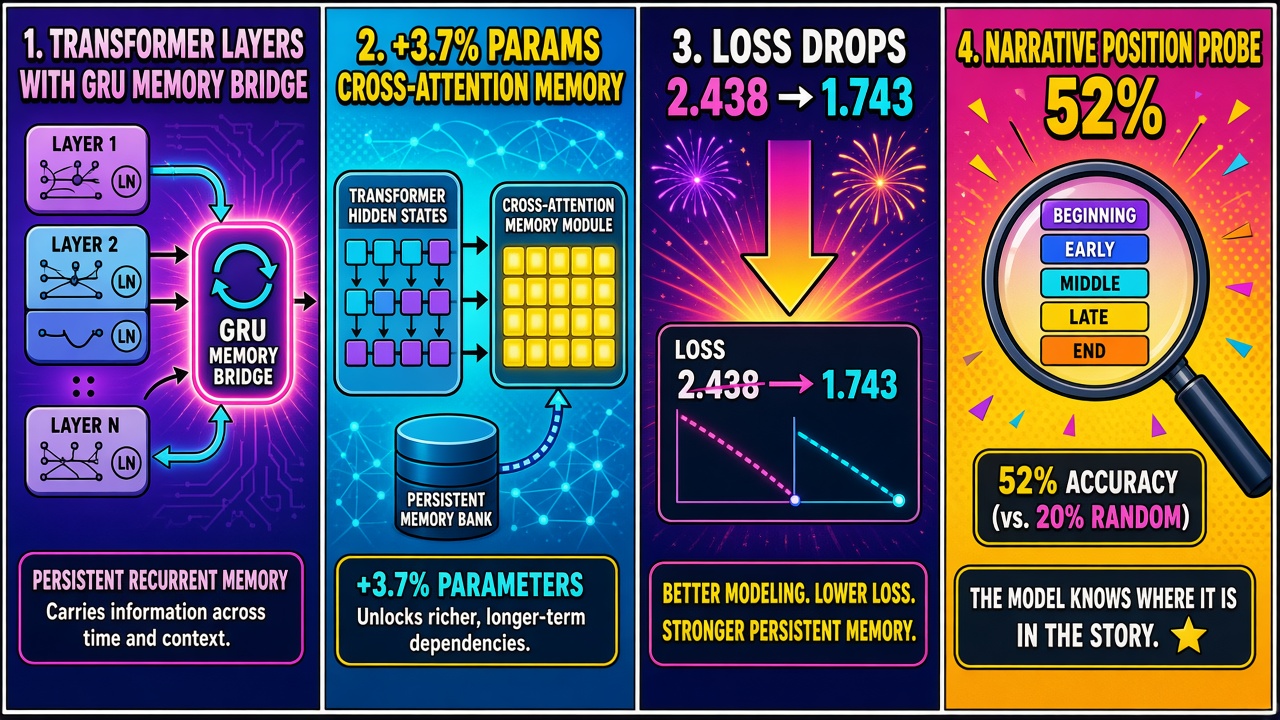
arXiv:2609.17251 [cs.CL], submitted September 15, 2026, presents Persistent Recurrent Memory Between Transformer Layers — Improves Language Model Generalization by Eduardo Novaes Hering. The abstract describes a persistent recurrent state passed between the lower and upper halves of a 6-layer transformer via cross-attention, a GRU update, and gated addition, adding about 3.7% parameters. That is the AI filing: a dated abstract with a named topology and measured deltas, not a product pitch.
Reported results: evaluation loss falls from 2.438±0.004 to 1.743±0.018 — a 28.5% reduction — across five seeds with p<0.01. The generalization gap shrinks to 0.12 versus 0.26 for the baseline. Ablations attribute the improvement to the persistent-memory topology rather than an auxiliary loss. A narrative position probe lands at 52% versus 33% chance. This desk files research summaries, not jailbreak recipes, attack prompts, or exploit steps. Educational AI reporting only. Bright neon purple and latent teal. White gutters. Stick to the abstract’s named claims — no invented benchmarks beyond what the abstract states. If a panel overclaims, the verified prose wins.
AI packages prefer a clear mechanism claim over hype adjectives. Readers get arXiv:2609.17251, Hering’s authorship, the cross-attention / GRU / gated-addition recurrent bridge across 6-layer halves, the +3.7% parameter note, the 2.438→1.743 eval-loss drop (28.5%), five-seed p<0.01, the 0.12 vs 0.26 generalization gap, the ablation that credits topology not auxiliary loss, and the 52% vs 33% narrative position probe — not a claim that every prior transformer is obsolete.
Why it matters
A paper that inserts a persistent recurrent state between transformer-layer halves and measures a large eval-loss cut plus a tighter generalization gap is the strip: layer-split board, memory loop, 2.438→1.743 stamp, 0.12 vs 0.26 gap. Color on the recurrent edges and the loss drop. White gutters. Keep politics out. Keep the arXiv URL on the page. Abstract-only filing — no invented numbers beyond the abstract.
Conclusion
arXiv:2609.17251 by Eduardo Novaes Hering introduces persistent recurrent memory between the lower and upper halves of a 6-layer transformer via cross-attention, GRU update, and gated addition (+3.7% params), reporting eval loss 2.438±0.004 → 1.743±0.018 (28.5% reduction, five seeds, p<0.01), a generalization gap of 0.12 vs 0.26, ablations crediting the memory topology rather than auxiliary loss, and a narrative position probe at 52% vs 33% chance. Source: https://arxiv.org/abs/2609.17251
Source: arXiv