
Technology and AI
DA-DLM adapts DAG dependency modeling to diffusion LMs
What happened
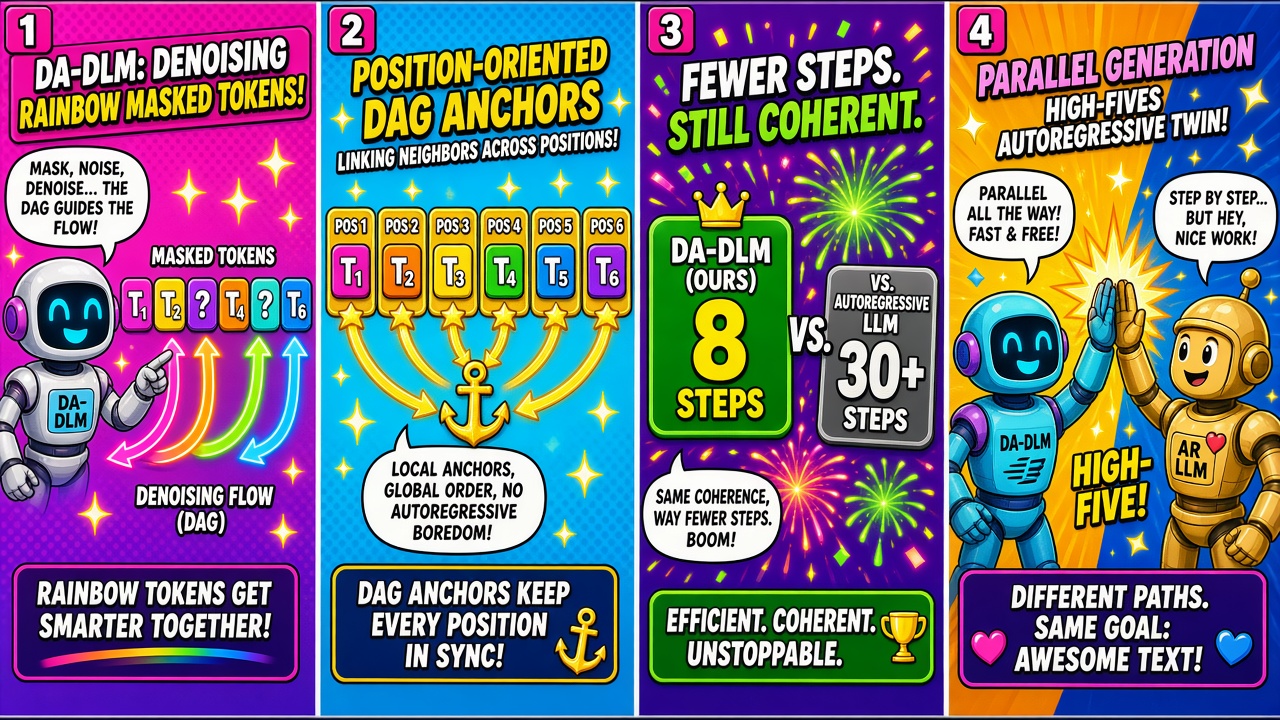
arXiv:2609.15070, submitted September 14, 2026, introduces DA-DLM — a Directed Acyclic Diffusion Language Model that adapts Directed Acyclic Graph (DAG) dependency modeling to Diffusion Language Models (DLMs). The abstract notes that DLMs generate text by iteratively denoising a masked sequence and independently predicting multiple tokens at each step; that conditional independence discards inter-token dependencies and degrades coherence, a problem that parallels multi-modality issues in Non-Autoregressive Translation (NAT). Drawing on the Directed Acyclic Transformer (DAT) approach used in NAT, the authors propose a position-oriented DAG design for the iterative DLM setting.
The position-oriented DAG binds node groups to fixed output positions so that tokens fixed in earlier steps can anchor neighboring predictions via learned transitions, and the graph evolves with denoising to focus on remaining uncertainty as anchors accumulate. On language modeling, open-ended generation, and summarization, the abstract reports that DA-DLM consistently outperforms Block Diffusion, especially under fewer denoising steps, and matches autoregressive models while preserving parallel generation. Authors listed on the abstract page include Pengyu Ji, Zichen Zhang, Xiang Hu, and Kewei Tu. This desk files research summaries, not jailbreak recipes, attack prompts, or exploit steps. Educational AI reporting only. Bright neon purple and latent teal. White gutters. Stick to the abstract’s named claims — no invented percentages, parameter counts, or benchmark deltas beyond what the abstract states. If a panel overclaims, the verified prose wins.
AI packages prefer a clear mechanism claim over hype adjectives. Readers get arXiv:2609.15070, the DLM conditional-independence problem, the DAT/DAG lineage, the position-oriented DAG binding, the Block Diffusion comparison (especially fewer steps), and the match-to-AR-while-parallel line — not a product pitch and not a claim that every prior diffusion LM is obsolete.
Why it matters
A paper that ports DAG dependency modeling into iterative diffusion LMs via a position-oriented design is the strip: masked denoising grid, DAG binding board, fewer-steps win over Block Diffusion, parallel generation that still matches AR. Color on the DAG edges and the parallel stamp. White gutters. Keep politics out. Keep the arXiv URL on the page. Abstract-only filing — no invented numbers.
Conclusion
arXiv:2609.15070 presents DA-DLM, which adapts DAG-based dependency modeling to diffusion language models through a position-oriented DAG, reporting consistent gains over Block Diffusion especially with fewer denoising steps while matching autoregressive quality and keeping parallel generation. Source: https://arxiv.org/abs/2609.15070
Source: arXiv