
Technology and AI
MIT’s CW-Net helps humans predict self-driving mistakes
What happened
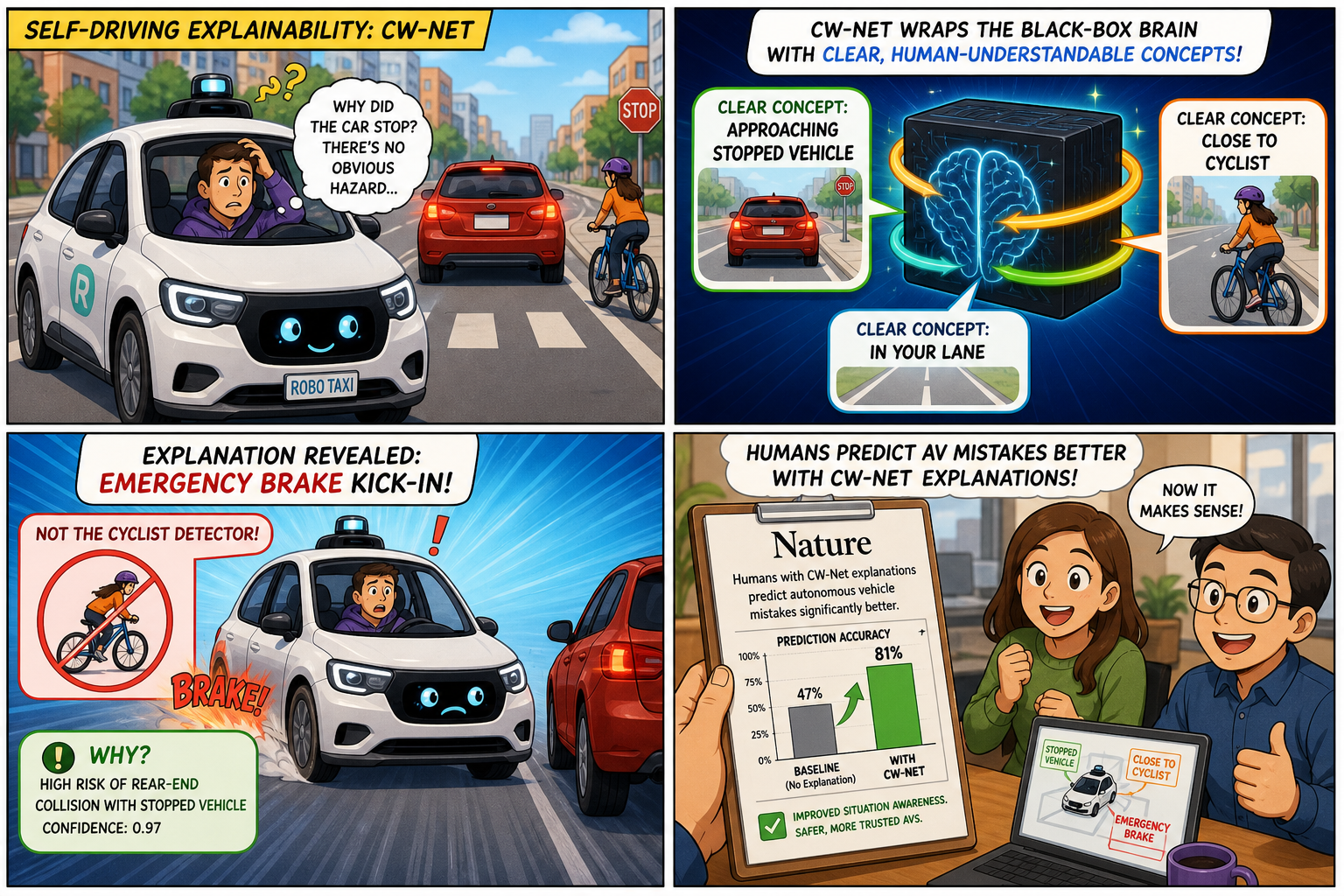
MIT News, dated 2 September 2026, reports a Nature paper on CW-Net, the Concept-Wrapper Network, from MIT’s Interactive Robotics Group and Motional. Self-driving planners are often black boxes: cameras and lidar go in, a trajectory comes out, and a safety driver may not know why the car phantom-braked. CW-Net plugs into the middle of an existing machine-learning planner, translates internal reasoning into understandable concepts such as “approaching stopped vehicle” or “close to cyclist,” and forces the final planning stage to use those concepts so the explanations stay causally faithful. Lead author Eoin Kenny and co-senior authors Julie Shah and Momchil Tomov are named on the MIT story. Motional teammates including Akshay Dharmavaram, Sang Uk Lee, Tung Phan-Minh, Shreyas Rajesh, Yunqing Hu, and Laura Major are also credited. The module was trained on a dataset of about 130 million labeled driving scenes.
On a private track with a Motional robotaxi, CW-Net helped a safety driver predict surprising vehicle behavior more accurately. In one case the car always stopped near a cyclist; the driver assumed cyclist detection. CW-Net showed the model was not configured to detect the cyclist and that emergency braking had fired when the car got too close — information that lets a driver slow earlier and helps engineers fix the model. Larger online simulations using Las Vegas road scenes showed the same pattern: explanations improved participants’ ability to predict what the AV would do next. Kenny stresses that in high-stakes settings the explanations must not mislead; because CW-Net is causally faithful, the concepts are tied to the decisions rather than slapped on afterward.
The planners themselves still act as the brain of the car. CW-Net is designed to mimic their driving decisions so the wrapper does not hurt performance while it talks. Shah frames the work as building technologies people can rely on and predict. That is the filing: a Nature-ready method that turns opaque stops into labeled concepts a human can act on.
Why it matters
Attribution and interpretability are recurring AI beats on this desk. An earlier package asked whose training image authored a print. Today’s asks why the robotaxi stopped. The comic is the confused rider, the concept wrap, the emergency-brake reveal, and a Nature clipboard. Bright car colors. No brand logos. Not a how-to for hacking cars. A lab result about situational awareness for safety drivers and for the engineers who have to debug the planner afterward.
Conclusion
CW-Net wraps AV planners in human-readable concepts, helped track drivers and online participants predict mistakes, and landed in Nature per MIT News Sept. 2. Source: https://news.mit.edu/2026/system-helps-humans-predict-when-self-driving-cars-will-make-mistakes-0902
Source: MIT News