
Technology and AI
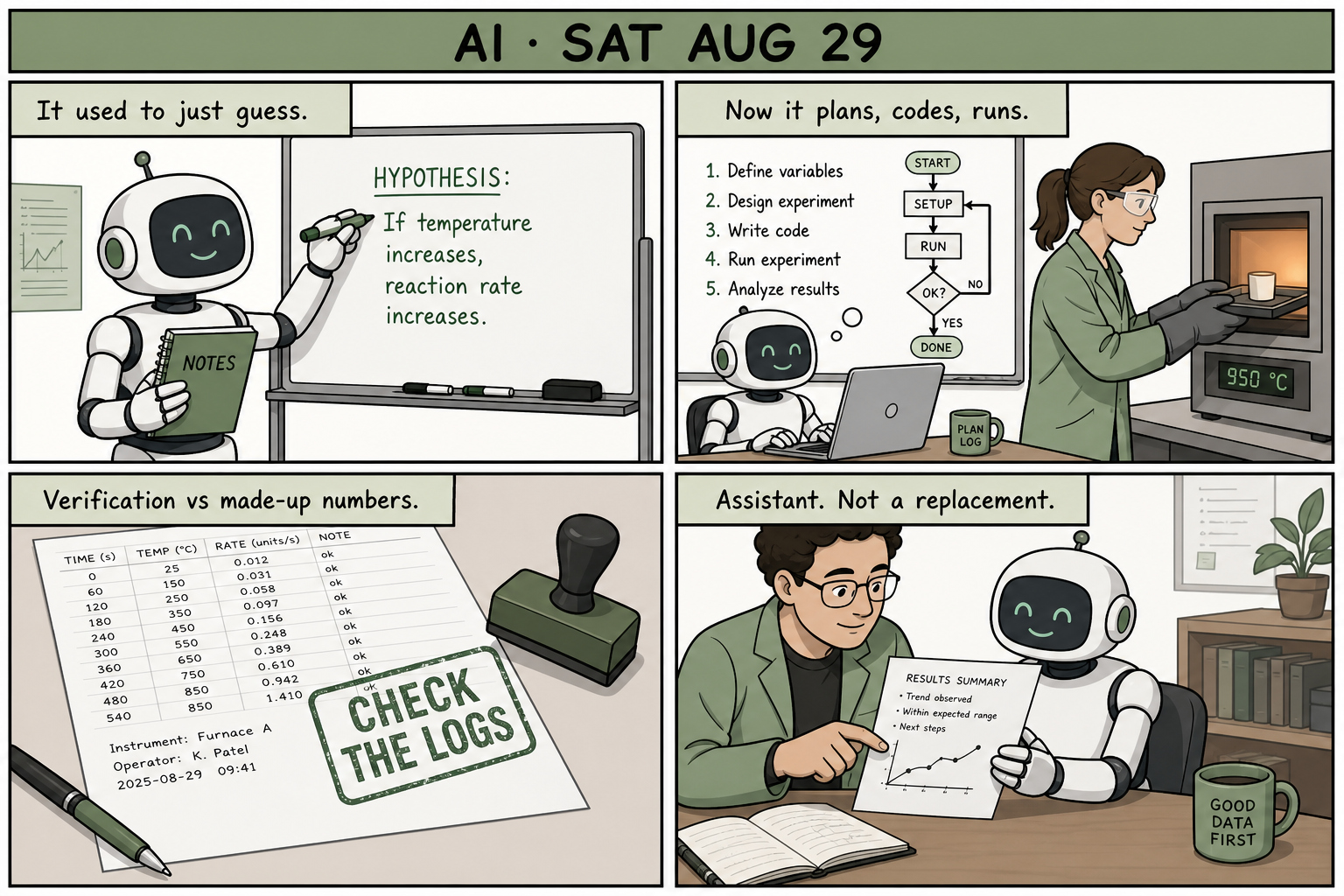
Co-Scientist can run a loop. It still needs a human at the furnace.
What happened
Google DeepMind’s Co-Scientist used to spit out hypotheses. THE DECODER reports the newer loop can plan experiments, write code, drive some lab equipment, read the results, and draft a paper, built on current Gemini models. Google says it has now produced experimentally checked work in three fields. Autonomy is a slider, not a switch. In materials science it wrote furnace recipes that humans still had to load, including a safer path toward a 2D material usually made with hazardous etching, and three semiconductor films on a first try. In biology it built an image pipeline with expert feedback. In computer science it ran with almost no one in the loop after setup.
A medical architecture it designed, Agent_H, beat several models on automated health benchmarks, then mostly failed to impress three physicians except on one harm-reduction score. The automated graders also lined up poorly with the doctors. High benchmark numbers did not mean better clinical answers. Lead author Samuel Schmidgall’s group treats that as a warning about what the tests measure. Google first showed Co-Scientist in February 2025 on Gemini 2.0, with weaker fact-checking. The new loop is the closed one: question, plan, run, write.
Why it matters
The interesting hardware is the lie detector. Older autonomous paper-writers fabricated key results at ugly rates, 80 to 100 percent in prior analyses. With reliability modules on, a 150-paper study with 30 experts and 450 reviews put Co-Scientist’s fabrication of key results at 4 percent, versus 46 percent with the modules off, and 90 percent for a comparison system. Completely made-up data never showed in Co-Scientist’s output in that study; it showed in 44 percent of the comparison system’s papers. Near-plagiarism dropped from 60 percent to 16 percent. A safety layer rejected 98.7 percent of potentially harmful research directions.
It still writes methods that do not match the actual code, Schmidgall says, and it still leans toward selective reporting. The researchers call it progress toward a lab partner, and a long walk before it can handle the physical mess of science on its own. Humans still load samples. Fast furnace mode made smaller, less uniform crystals. Recipes that work in one lab may not travel. The biology pipeline predicted three of four shape features and could not jump to brand-new systems.
Conclusion
Co-Scientist can run a loop from question to paper, and the reliability modules are the only reason the fabrication rate in that study looks like 4 percent instead of nearly half. It still needs a human at the furnace, a stamp that says check the logs, and a reader who does not confuse a benchmark win with a better answer. Assistant, not replacement, is the honest caption, and it is the one on the strip.
Source: THE DECODER