
Culture and Curiosity
Angélique Kidjo plants the first African music star on Hollywood Boulevard
What happened
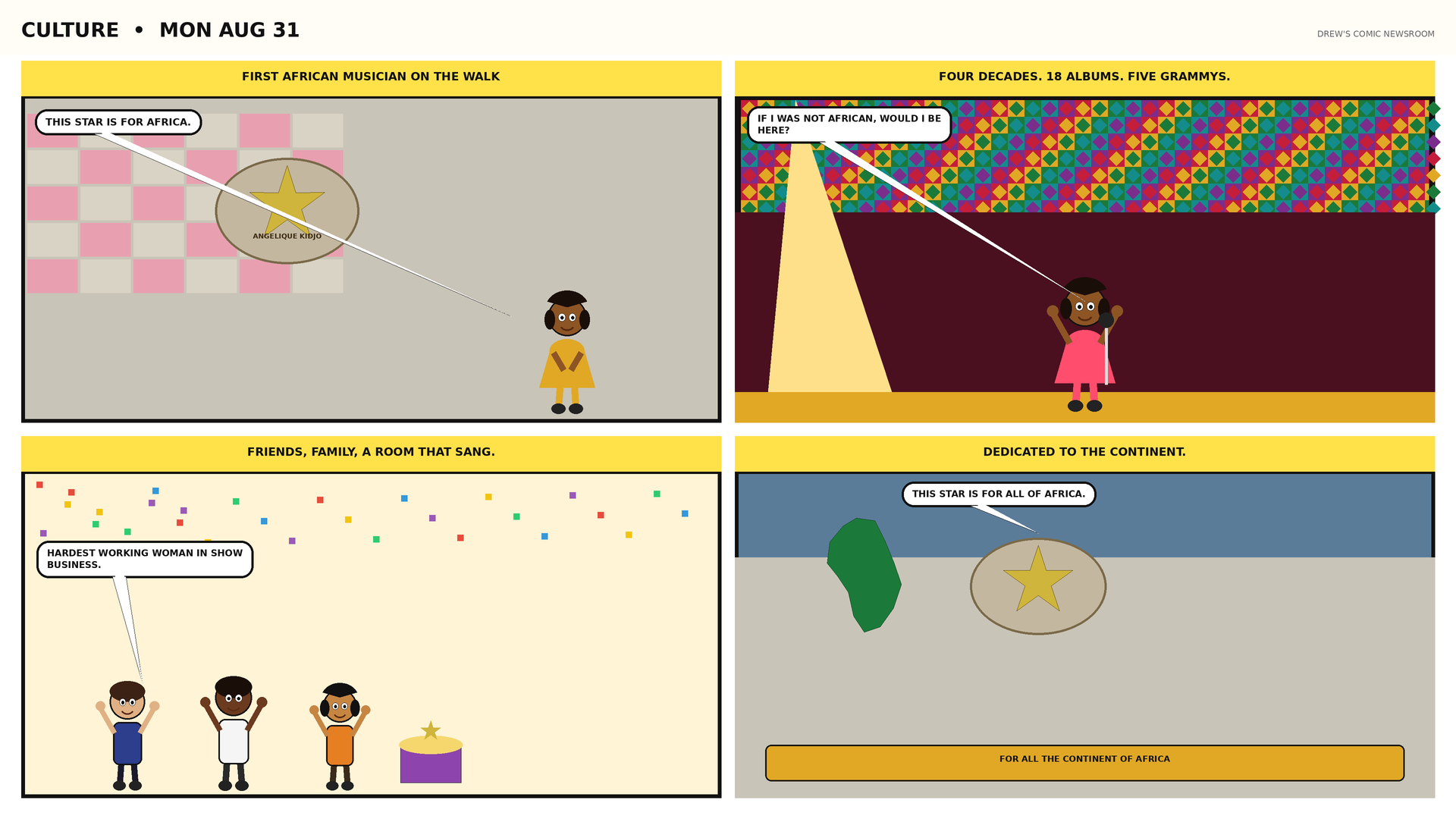
Angélique Kidjo became the first African musician with a star on the Hollywood Walk of Fame this week, and she would not let the terrazzo belong to her alone. Speaking to BBC Focus on Africa after the Los Angeles ceremony, the 66-year-old five-time Grammy winner from Benin said, “This star is for all the continent of Africa. Because if I was not African, would I be here?” Hafsa Khalil and Waihiga Mwaura’s BBC report, dated Aug. 20, is the source for the quotes, the guest list, and the career math. She had already made the same argument at the sidewalk itself, tying four decades of recordings to a longer map of sound: without the blues that came out of Africa, she told the gathering, there is no R&B, no rock and roll, no soul, no jazz. “All of it comes from Africa.” Variety, via Getty, caught the line that framed the afternoon: Africans, she said, still underestimate what they have given the world. The star is in the Recording category. The rest of the story, as she told it, is the music that got her there.
The gathering was a concert disguised as a civic plaque. Family and friends filled Hollywood Boulevard with singing and dancing. Among the guests were Hollywood actors Willem Dafoe and Djimon Hounsou — Hounsou is also from Benin — and Nigerian musician Adekunle Gold. Kidjo wiped away tears and told the BBC she was talking to her parents in her head. “At that moment, I’m like, dad, mum, I wish you were here with me to see [this].” She could not take the emotion. They were not there to taste the fruit of what they had created, she said, or to see how they had nurtured her curiosity and her love for music. Dafoe, introducing her, called her “without a doubt the hardest working woman in showbusiness” and likened the live voltage to James Brown, the hardest working man in the same sentence. The first time he saw her perform, he said, the music, the dancing, and the commitment were incredible. Harvey Mason Jr., CEO of the Recording Academy, said she had connected cultures, crossed borders, and reminded audiences that her music unites in a way few other things can. That is the ceremony the BBC printed, and it is the ceremony this recap is filing.
Why it matters
The catalog behind the plaque is not a footnote. Kidjo has released 18 albums and been nominated for 17 Grammys, winning five. She took the Polar Music Prize in 2023 and, two years earlier, a place on Time’s 100 Most Influential People. Her latest record, HOPE!!, arrived earlier this year with tracks produced by Pharrell Williams and collaborations with Ayra Starr, Quavo, Nile Rodgers, and Diane Warren. The older guest list on the records is just as stacked: Burna Boy, John Legend, Bono, Alicia Keys. Chris Blackwell, who signed her to Island Records in the 1990s and launched the breakthrough album Logozo, called to congratulate her after the star went into the pavement. She had asked him then whether she could do the music she wanted and keep her cultural identity without anyone imposing another sound on her shoulder. He told her it was a no-brainer. That answer is why a Beninese singer with a commanding voice and a habit of fusing West African styles with funk, jazz, pop, and R&B now has a Hollywood address in terrazzo.
Hollywood’s sidewalk already held more than 2,800 stars. Kidjo is the first African musician among them. She told the BBC she had not believed the nomination a year ago until her husband showed her the story on the BBC itself. Changes that last take time, she said, when asked what it meant to be first. The other work she carries does not fit on a star either. She is co-founder of the Batonga Foundation, which helps vulnerable young girls and women in Benin, a through-line of the same career that took African sounds to global rooms and then brought the rooms back to the sidewalk. Dafoe’s other line from the ceremony is the one that sits next to the Grammys: she is not only a performer, songwriter, and musician, but a kind and giving person. The phone kept ringing through the Focus on Africa interview. Blackwell had called. The star was already in the pavement. The argument she attached to it was older than the pavement: African music is not a side room. It is the root system under the rooms everyone else has been living in.
Conclusion
A 66-year-old from Benin now has a Hollywood star, five Grammys, 18 albums, a Polar Prize, a Time 100 nod, and a new record that still has Pharrell and Nile Rodgers in the credits, and she spent the afternoon insisting the plaque was for the continent. The guests danced. The parents were missed. Island Records got the thank-you it earned on Logozo. The strip’s four beats are the Recording star in the sidewalk, the map from blues to jazz drawn back to Africa, a daughter wiping a tear for the people who put the songs in her, and a HOPE!! street party that will not shrink the dedication to one name. That is the culture filing: first African musician on the Walk of Fame, dated Aug. 20 in the BBC, quoted as she said it, filed here as music.
Source: BBC News