
Culture and Curiosity
When the music stops: a Bill Evans film that barely plays the hits
What happened
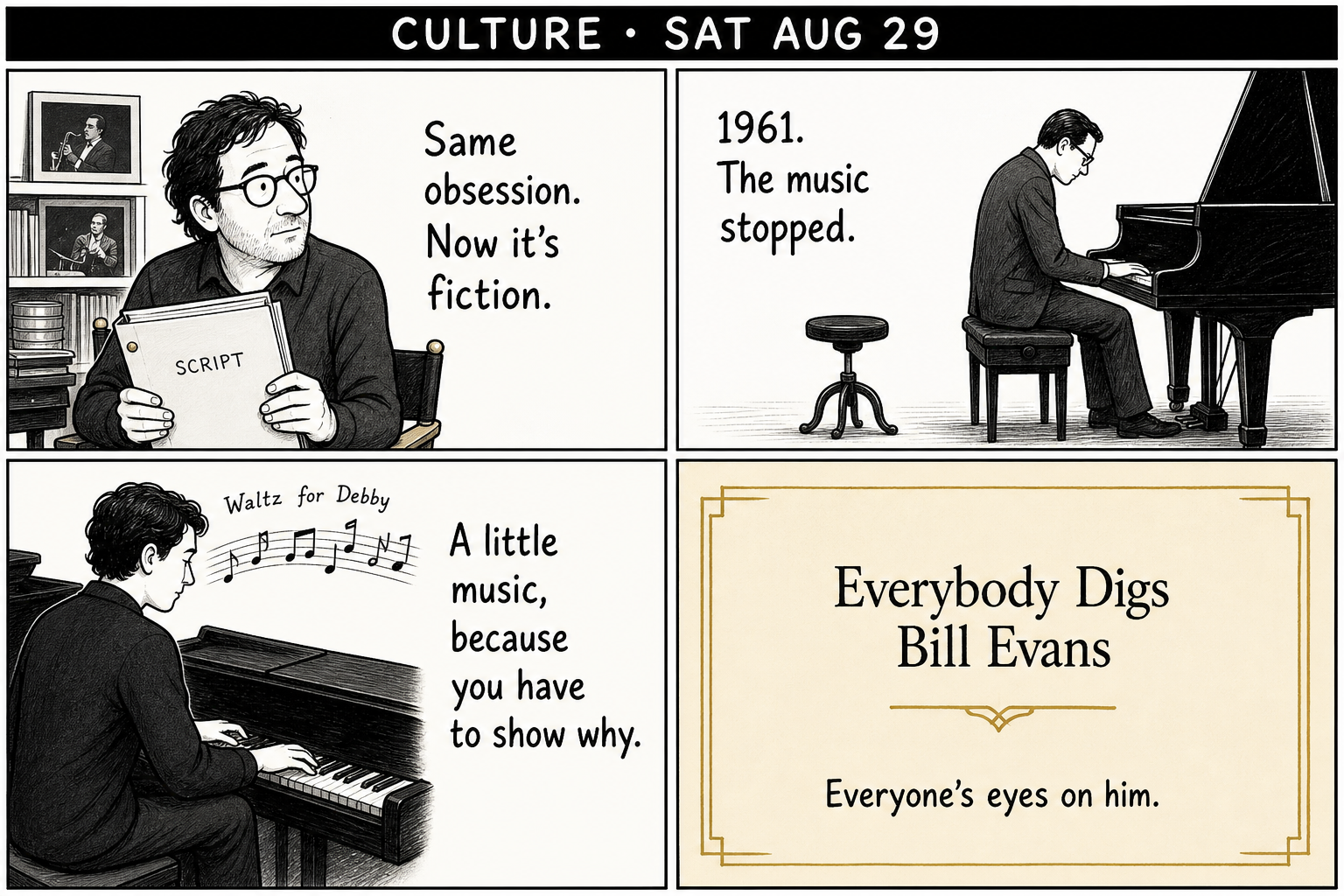
Grant Gee used to make music documentaries. The Guardian’s piece on Everybody Digs Bill Evans is about him sliding into fiction without dropping the same shape: a person in one state, a crisis, a return that is not quite the old self. The subject is Bill Evans, the pianist on Kind of Blue, the one who pulled Debussy into jazz. The film does not do the cradle-to-grave biopic. It stays in a few months of 1961, after bassist Scott LaFaro died, when Evans could barely sit at the piano.
Gee found him first in a Lee Friedlander photograph: Ivy League cool and visibly spooked. Owen Martell’s novel Intermission gave him a plot that is mostly aftercare, not concert footage — a brother in New York, parents in Florida, then back to Manhattan. Gee liked the idea of a music biopic with almost no performance. He did not quite dare it. Anders Danielsen Lie, a Norwegian actor, a doctor, and a real pianist who has transcribed Evans since he was a teenager, plays a few short recreations, including Waltz for Debby, written for Evans’s niece.
Why it matters
Most music films die, Gee says, when they cut to the actor playing the hits. This one is the story of what happens when the music stops. The title, borrowed from a 1959 LP, is not a compliment in Gee’s mouth. Everybody is watching. Evans cannot stand the care. It is an Anglo-Irish production shot in County Cork that still has to feel like Manhattan and Florida, with Bill Pullman and Laurie Metcalf as the parents. The real set is interior: the place an artist goes when the thing that makes him himself becomes unreachable.
Gee has told this shape before, from a Radiohead video of someone almost drowning to films about Joy Division, Bowie, and writers. Evans is the same loop in a quieter key. The ending uses Lucky to Be Me, a Bernstein song whose title sounds almost cruel after what the film has shown. Gee wanted a minor lift. Irony, then a little air. He talks about 1960s attitudes toward addiction without turning the recap into a case file; the film’s job, in his telling, is not modern diagnosis. It is the months when the piano is there and the player cannot sit down.
Conclusion
Everybody Digs Bill Evans is a fan’s compulsion turned into a chamber piece: a photograph that demanded a life, a novel that refused the concert tour, and a handful of bars so the audience knows why the silence is expensive. The music is there only enough to show why it hurts when it stops, which is why the strip leaves an empty bass stool in the second panel and saves the title card for last.
Source: The Guardian